Opening Hours
Daily: 10 A.M.–5 P.M.
Closed on Tuesdays
1151 Oxford Road
San Marino, CA 91108
Daily: 10 A.M.–5 P.M.
Closed on Tuesdays
1151 Oxford Road
San Marino, CA 91108

Image not available
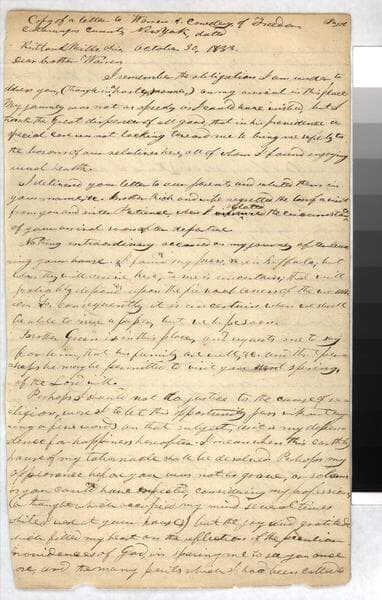
Manuscripts
The unbound letter book consists primarily of copies of letters written by Oliver Cowdery. They cover such subjects as his duties as editor of the Evening and Morning Star, problems regarding the procurement of printing equipment, his political aspirations, the persecution of Mormons in Missouri, discussion on church doctrine, and his excommunication from the church.
mssHM 63646-63653
Image not available
Manuscripts
The transcription consists primarily of copies of letters written by Oliver Cowdery. They cover subjects such as his duties as and problems associated with being the editor of the Evening and Morning Star, his political aspirations, the persecution of Mormons in Missouri, discussion on church doctrine, and his excommunication from the church.
mssHM 70170
![Statements on Oliver Cowdery and a Mormon pioneer company [microform]: after 1844](/_next/image?url=https%3A%2F%2Frail.huntington.org%2FIIIF3%2FImage%2F22APN4DZR830%2Ffull%2F%5E360%2C%2F0%2Fdefault.jpg&w=750&q=75)
Manuscripts
Microfilm of two brief statements on Mormon history made by Samuel W. Richards. The first gives a short account of Oliver Cowdery. The second describes Richards's learning while he was at Nauvoo in 1844 of the formation of a pioneer company intended to "find a suitable place for the Saints to move to where they could rest for a time from the constant harassing and persecutions to which ... [they] were then being subjected." Richards writes of council meetings involving Hyrum Smith and Sidney Rigdon and of the pioneer company's intentions to travel to California and Oregon, "if deemed necessary," since it was "thought Lower California would offer the greatest inducements for locating a city for the Saints." The whole is addressed to B.H. Roberts, Salt Lake City.
MSS MFilm 00166
Image not available
Manuscripts
Typescript of a brief biographical account of Martin Harris and his involvement with the translation of the Book of Mormon and organization of the Church of Jesus Christ of Latter-day Saints. Describes the arrival of a teenaged Joseph Smith in Palmyra, New York, in 1816, and his finding of the tablets later used to write the Book of Mormon; Harris' taking of a transcript of the tablets to Columbia University; his assistance to Smith in translating the tablets; and his inclusion as one of three witnesses (along with Oliver Cowdery and David Whitmer) who were permitted to view the tablets. Also briefly recounts Harris' involvement with selecting the Twelve Apostles of the Mormon Church and helping Joseph Smith find holy ground in Missouri, as well as Harris' disillusionment with the Mormon Church following Smith's death. Includes a transcript of a portion of Martin Harris' sworn testimony taken at the time of his death in 1845, in which he describes witnessing the angel Moroni and hearing the voice of God.
mssHM 72353
Image not available
Manuscripts
A facsimile of Tanner's paper asserting that the Book of Mormon has always condemned plural marriage and that Mormon leaders in various periods believed that if Joseph Smith's revelation concerning polygamy were false, the entire Mormon religion would be false. The manuscript is a compliation of annonated citations from numerous religious publications (including the Book of Mormon, Doctrine and Covenants, History of the Church, and the Bible) and from the writings, speeches, and testimony of several important figures in the history of the Church of Jesus Christ of Latter-day Saints and the Senate hearings on the election of Reed Smoote, a Mormon apostle, to Congress (1904-1907).
mssHM 69947
Image not available
Manuscripts
The original of the Reed Peck Manuscript, an 1839 memoir criticizing Mormon actions in Missouri during the conflicts of 1838. Peck opens with a prophecy about "redeeming" Zion (Missouri) through armed force, the "interpretation" of which led Joseph Smith to call for volunteers to march to Clay County "under arms" (they were waylaid by a cholera outbreak). Peck goes on to relate alleged financial and power conflicts in Kirtland, Ohio, between, among others, Joseph and Hyrum Smith, Sidney Rigdon, and Oliver Cowdery, as well as disagreements over where in Missouri to establish a Mormon settlement. He writes that once the Mormons had settled in Caldwell County, the Mormon presidency became a "despotic government" and that it proposed a policy, encouraged by Rigdon, that dissenters from the Church be killed so that "they would not be capable of injuring the church." He goes on to say that the Mormon leadership demanded that all followers consecrate their property to the Church or be turned over to the "terrible brother of Gideon" (Jared Carter) for punishment. Peck continues that he and some others were "ever after ... opposed to the rule of the presidency" because "their word was law in religious, civil and military matters." He writes of the formation of a "secret military organization" (the Danites) by Carter, George W. Robinson, and Sampson Avard "under the instruction of the presidency," and of pretending to join the group, although he avoided taking the official oath and "declared to my trusty friends that I would never act in the office." He also remembers that Carter was later found guilty of criticizing the presidency, and alleges that he heard Joseph Smith say he would have "cut his throat on the spot" if he had been alone. The remainder of the memoir recounts the events of the Mormon War, in which Peck claims that hostilities between Mormons and Gentiles were inflamed by Joseph Smith. He begins with disputes over an election in Daviess County, leading to a "skirmish" which he says was exaggerated into accounts of a "bloody massacre of ... Mormons," leading non-Mormon citizens to fear retaliation and call for the expulsion of the Mormons from Daviess County. He criticizes the Mormons for initiating confrontations, plundering goods, and for attacking the militia under Capt. Bogart at the Battle of Crooked River, but he condemns the attack on Mormons in the Haun's Hill Massacre. He concludes his narrative of events with the arrest and subsequent escape of the Smiths, Rigdon, Wight, Parley Pratt, and others. He closes the manuscript by condemning Smith and the Church ("how can he [Smith] expect to support his character as a man of God when facts are exhibited to the world in their true light," he wrote) and by listing the sources for his narrative, much of which was allegedly based on his own eyewitness accounts. Other individuals mentioned in the memoir include W.W. Phelps, Edward Partridge, John Corrill, and Dimmock Baker Huntington. There appear to be pages missing after page 152.
mssHM 54458