Manuscripts
Works by and attributed to Ovid : [manuscript]
1 of 6
- Description
- ff. 1-43; ff. 43v-44 blank. [Ovid] Ars amatoria. Incipit: Si quis in hoc artem populo non novit amandi. Explicit: Inscribant foliis [sic] Naso magister erat. Finis. Latin. E. J. Kenney, ed., P. Ovidii Nasonis Amores, Medicamina Faciei Femineae, Ars Amatoria, Remedia Amoris (Oxford 1961) 113-200. ff. 45-59v; f. 60r-v blank. [Ovid] De remedio amoris. Incipit: Legerat huius amor titulum nomenque libelli. Explicit: Carmine sanati foemina virque meo. Finis. Latin. Kenney (1961) 205-37. ff. 61-133. [Ovid] Heroides. Incipit: Hanc tua Penelope lento tibi mittit Ulyxes. Explicit: Ut mihi Leucadie fata petantur aquae. Latin. H. Dorrie, ed., Epistulae Heroidum (Berlin 1971) 47-286, 314-29; the letter of Sappho to Phaonis is at the end, and the letters of Oenone and Canace are preceded by the introductory couplets: f. 71v,"Nympha suo Paridi quamvis suus esse recusat/ Mittit ab Idaeis verba legenda iugis," and f. 89"[A]eolis Aeolide quam non habet ipsa salutem/ Mittit et armata verba notata manu.". f. 133r-v. Incipit: Sapho Simonis ut alii putant Eumeni, ut alii Erigii ut alii ecripti. Explicit: ex leucade se deiecit. Latin. From Suidas, Lexicon (Basle [1564]), col. 873, lines 1-23, with some variation. The note is followed by 4 couplets relating to Sappho from Antipater Sydonius, Ausonius, Papinius and Horace. ff. 133v-140; f. 140v blank. [Aulus Sabinus] Responses to the Heroides. Incipit: Pertulit ad miserum tandem tua casus Ulyxem. Explicit: Sive tuos vigiles pellere sine meos. Latin. Responses to 3 letters of the Heroides attributed to Sabinus (Ulysses to Penelope; Demophoon to Phyllis; Paris to Oenone); see Publii Ovidii Nasonis quae extant Opera Omnia, ed. N. E. Lemaire (Paris 1820) 1:17-25, 43-49, 115-21. On f. 133v, biographical note on Aulus Sabinus (A[ulus] Sabi[n]us eques Romanus celeberrimus vatesque Nasonis temporibus floruit . . . ) and 2 quotations from Ovid (Amores, 2, 18, vv. 27-34, Quam cito de toto tediit celer orbe sabinus . . . Dat votum phoebo Lesbis amica Lyrae; and Ex Ponto, 4, 16, vv. 13-16, Et qui penelope rescribere iussit Ulyxem . . . Deseruit celeri morte sabinus opus). ff. 141-186v. [Ovid] Amores. Incipit: Qui modo nasonis fueramus quinque libelli. Explicit: Post mea mansurum fata superstes opus. Latin. Kenney (1961) 5-100. f. 187r-v. [Pseudo Ovid] Pulex. Incipit: Parve pulex et amara Lues inimica puellis. Explicit: Et iam nil mallet quam sibi me socium. Latin. F. W. Lenz,"De Pulice Libellus," Maia 14 (1962) 299-333. ff. 187v-189. [Pseudo Ovid] Philomena. Incipit: Dulcis amica veni noctis solatia prestans. Explicit: Seu semper sileant sive sonare queant. Latin. For a critical edition of the text and a list of manuscripts, including HM 1038, see P. Klopsch,"Carmen de philomela," Literatur und Sprache im Europäischen Mittelalter: Festschrift für Karl Langosch zum 70 Geburtstag, ed. A. önnerfors, J. Rathofer, F. Wagner (Darmstadt 1973) 173-94. ff. 189-191. [Ovid] Medicamina faciei. Incipit: Discite que faciem commendat [sic] cura puellae. Explicit: Contereret teneris illineretque genis. Latin. Kenney (1961) 103-07. ff. 191-194. [Pseudo Ovid] Nux. Incipit: Nux ego iuncta viae cum sim sine crimine vitae. Explicit: Parcite sic coeptum perficiatis iter. Latin. F. W. Lenz, ed., P. Ovidii Nasonis Halieutica Fragmenta, Nux, Incerti Consolatio ad Liviam. Corpus Scriptorum Latinorum Paravianum (Turin 1956) 127-56. ff. 194-203; f. 203v blank. [Pseudo Ovid] Ad Liviam Augustam Consolatio. Incipit: Visa diu felix mater modo dicta neronum. Explicit: Livia funestam dedecet esse domum. Finis. Latin. Lenz (1956) 177-210.
- Date
- [between 1485 and 1499]
- Call number
- mssHM 1038
- Provenance
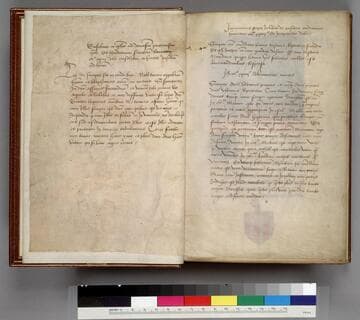
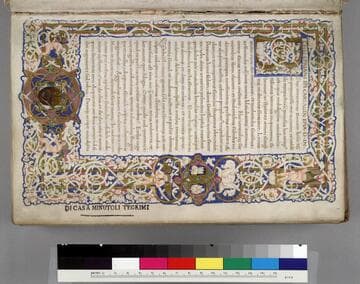
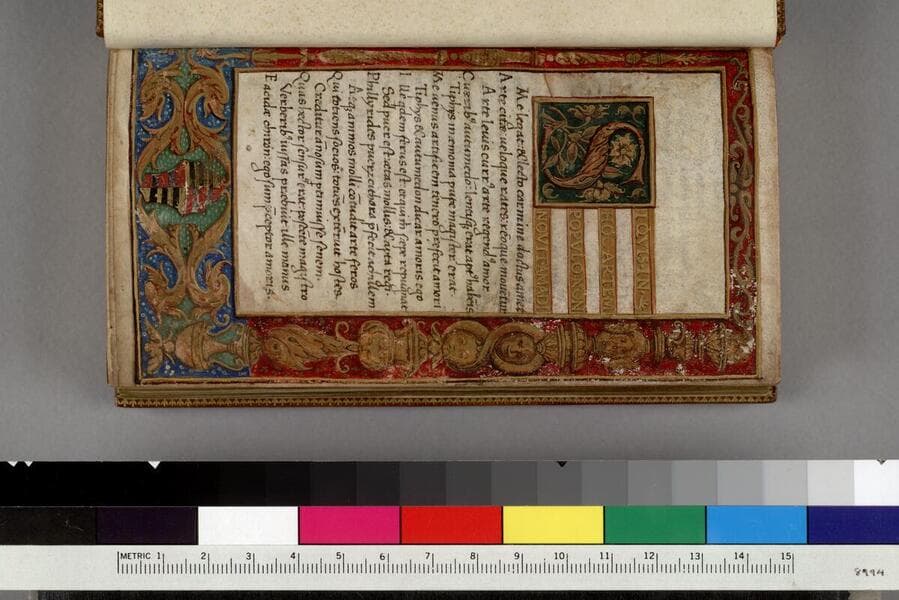
- Written in Naples where Clemens Salernitanus is known to have worked: T. De Marinis, La Biblioteca napoletana dei Re d'Aragona (Milan 1947-52) 1:66 identified the hand of this scribe with a Clemente Genovesi da Salerno mentioned in a Neapolitan document of 1487, who copied a "Trattato di mascalcia," now lost. HM 1038 shares script, decoration and pocket-size format with several other manuscripts of classical texts, such as a Martial (formerly J. A. 3183, now belonging to B. S. Cron of Kew, England, Add. MS 7), an Ovid and a Virgil (Baltimore, Walters Art Museum, W. 385 and 400), a Florus (Vatican, Barb. lat. 7; signed), and a Tibullus and Virgil (Wolfenbüttel, Herzog-August Bibliothek 63.5 Aug. 8o; signed). This manuscript was apparently copied from the edition of Ovid printed by Hermann Liechtenstein in Vicenza, 1480 (Hain-Copinger 12141). Overall order is similar, in blocks: the printed text gives Heroides, the Sappho material, the Sabinus material, Amores, (here ff. 61-186v); Ars amatoria, De remedio amoris (here ff. 1-59v); Ibis, Fasti, De tristibus, Ex Ponto (not in this manuscript); Pulex, Philomena, Medicamina faciei, Nux, Ad Liviam (here ff. 187-203). De remedio amoris is divided into two books, both in the manuscript and in the 1480 edition. The 2 match in the presence or absence of supplemental material: two introductory couplets in the Heroides, the sections on Sappho and Sabinus, three responsory letters. They correspond in variant readings, in spellings (except for greater frequency of the diphthong ae in the printed text), and capitalization. The occasional incorrect initial in the manuscript (ff. 89, 168, 170, 180v) may be due to the fact that the initials were not printed in the 1480 edition, but left blank to be filled in by hand. This correspondence was first observed by M. D. Reeve. On ff. 1 and 141 of HM 1038, the arms of the original owner: quarterly 1 and 4, or three bars sable, 2 and 3 gules two bars and 9 martlets argent 3, 3, and 3. On f. 203 the erased inscription, s. XVI: Dono accepit Augustinus Amodeus a Domino Dominico Seglia. Later owned by Ambroise Firmin Didot (1790-1876); his sale, Paris, 9 June 1881, n. 7 to Techener; Baron François Florentin Achille Seillière (1813-73); his sales, Paris, 1890, n. 1221, and 1893, n. 146. Belonged to Robert Hoe: Bierstadt (1895) p. 18; Cat. (1909) pp. 152-53; his sale, Anderson, New York, 1911, pt. I, n. 2169 to G. D. Smith. Precise date of acquisition by Henry E. Huntington unknown.
- Restrictions
- RESTRICTED. Available with curatorial approval. Requires extended retrieval and delivery time.
- Dimensions
- 76 x 150 mm
- Associated people
- Salernitanus, Clemens,
- Majorana, Cristoforo
- Associated organization
- Henry E. Huntington Library, Art Museum, and Botanical Gardens.