Visual Materials
Navajo indian silver jewelry

You might also be interested in
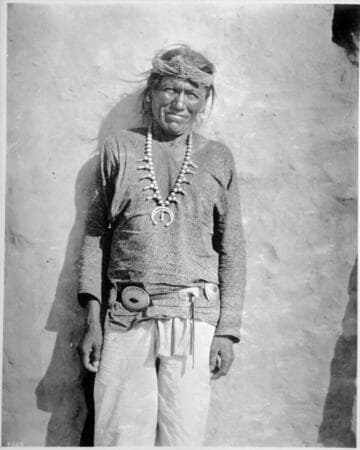
Navajo; a "friendly" with a solid silver neck ornament and belt
Visual Materials
Navajo man with necklace
photCL Pierce 02281
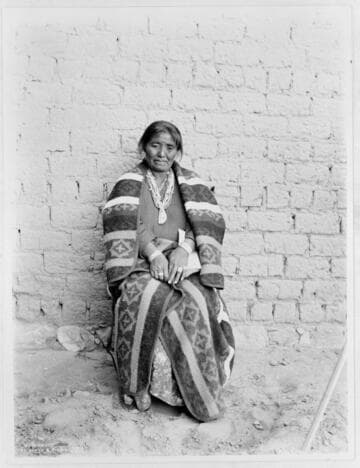
Navaho Indian woman; the daughter of the great chief Manuelito, wearing the finest blanket, jewelry and wampum
Visual Materials
Portrait of Navajo woman
photCL Pierce 02207
Image not available
Navajo Indians, including: an unidentified young married couple; individual female tribe members (some making bread, others wearing Navajo jewelry)
Visual Materials
A collection of photographs and postcards focusing on Navajo and Hopi Indians and various Indian schools and schoolchildren throughout Arizona, mostly in ca. 1927. There are views of Peach Springs Trading Post, the Cameron Suspension Bridge trading post, missions at Chinle and Lukachukai (Arizona), Navajo family groups, Navajo schools at Tuba City and Oraibi (Arizona), and Navajo school crafts fairs and exhibits. Acoma, Apache, Tohono O'Odham (Papago), and Hualapai Indians are also represented. The photographs were taken from 1890 to 1927, but the bulk of the collection was created during the 1920s. Includes some photographs by George Wharton James, E.E. Hall, and Burton Frasher (Frasher Fotos). These images of Indians were taken as both posed and candid field photographs, in particular of young Navajo schoolchildren during class time and outside of school. Other subjects pictured are L.H. McSparron, owner of Thunderbird Ranch and acting custodian of Canyon de Chelly; Father Leopold Ostermann, the founder of the mission at Chinle; possibly John Lorenzo Hubbell Jr., of the Hubbell trading family; an Indian all-boys track-and-field team at an unidentified school; Indian schoolchildren; and nature views throughout Arizona. The photographs have been arranged by Indian tribe, starting with the tribe with the most photographs and/or postcards. Navajo Indians appear first in the arrangement, followed by Hopi, Apache, and other Southwestern tribes with fewer photographs. Within each tribe, photographs and postcards have been further organized by individual tribe members, activities, crafts, associated communities, and schools. Images of Caucasian people involved in Indian trade, trading posts, and unidentified Indian schools and students are placed at the end of this collection. Russell also collected postcards with images of Southwest Indians, with some cards having correspondence from Russell, addressed to Beatrice Madelleine, Mrs. George R. Simmons, and Madeleine Touchaux (Russell's wife), describing how travel conditions were as well as opinions on the Indians that were encountered.
photCL 399
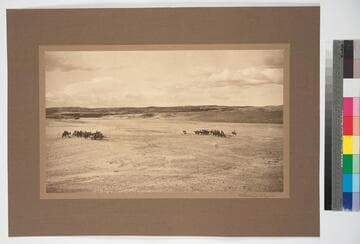
A Navajo Indian Race
Visual Materials
Two groups of Navajo on horseback gathered in the desert, watching horseback riders racing each other.
photCL 312
Image not available
Navajo Indians, including: individual female tribe members (many wearing Navajo jewelry and are with other female tribe members); tribe members gathering together at a meeting place; "Squaw Dance."
Visual Materials
A collection of photographs and postcards focusing on Navajo and Hopi Indians and various Indian schools and schoolchildren throughout Arizona, mostly in ca. 1927. There are views of Peach Springs Trading Post, the Cameron Suspension Bridge trading post, missions at Chinle and Lukachukai (Arizona), Navajo family groups, Navajo schools at Tuba City and Oraibi (Arizona), and Navajo school crafts fairs and exhibits. Acoma, Apache, Tohono O'Odham (Papago), and Hualapai Indians are also represented. The photographs were taken from 1890 to 1927, but the bulk of the collection was created during the 1920s. Includes some photographs by George Wharton James, E.E. Hall, and Burton Frasher (Frasher Fotos). These images of Indians were taken as both posed and candid field photographs, in particular of young Navajo schoolchildren during class time and outside of school. Other subjects pictured are L.H. McSparron, owner of Thunderbird Ranch and acting custodian of Canyon de Chelly; Father Leopold Ostermann, the founder of the mission at Chinle; possibly John Lorenzo Hubbell Jr., of the Hubbell trading family; an Indian all-boys track-and-field team at an unidentified school; Indian schoolchildren; and nature views throughout Arizona. The photographs have been arranged by Indian tribe, starting with the tribe with the most photographs and/or postcards. Navajo Indians appear first in the arrangement, followed by Hopi, Apache, and other Southwestern tribes with fewer photographs. Within each tribe, photographs and postcards have been further organized by individual tribe members, activities, crafts, associated communities, and schools. Images of Caucasian people involved in Indian trade, trading posts, and unidentified Indian schools and students are placed at the end of this collection. Russell also collected postcards with images of Southwest Indians, with some cards having correspondence from Russell, addressed to Beatrice Madelleine, Mrs. George R. Simmons, and Madeleine Touchaux (Russell's wife), describing how travel conditions were as well as opinions on the Indians that were encountered.
photCL 399
Image not available
Edith Metcalf Collection of Navajo Indian Lantern Slides
Visual Materials
This collection contains lantern slides that depict Baptist missionary work with Navajo Indians at Two Gray Hills Mission near Ship Rock, New Mexico, at the beginning of the twentieth century. The depicted missionaries include Baptist preachers E.E. Chivers, N.B. Rairden, O.B. Sarber and his wife, and R. B. Wright and his wife and daughters (Helena and Clara). The lantern slides show Christian hymns and Bible illustrations designed to help educate the Navajos in the Christian faith, Navajo interpreter Tom Cartin(?), Navajo mission helper Gertrude, Joseph R. Wilkin and his trading post, Navajo women weaving, Navajo children at the mission school, Navajo men gambling, Ute Indians, hogans, a sweathouse, Navajos working in the cornfields, Ship Rock, a mission school with Navajo children, a silversmith, sheepherders, and the New Mexico desert. Also included in this collection are copy transparencies that appear to be made from negatives that are not in this collection. These copy transparencies have no accompanying information, but they do seem to have been created around the same time as the lantern slides. The copy transparencies show portraits of Tom Cartin(?) and Gertrude, Navajo men on horseback, Navajo women and their children, desert landscapes, Baptist missionary families (including the Wrights), pictographs, and horses and wagons.
photCL 517