Opening Hours
Daily: 10 A.M.–5 P.M.
Closed on Tuesdays
1151 Oxford Road
San Marino, CA 91108
Visual Materials
Daily: 10 A.M.–5 P.M.
Closed on Tuesdays
1151 Oxford Road
San Marino, CA 91108

Visual Materials
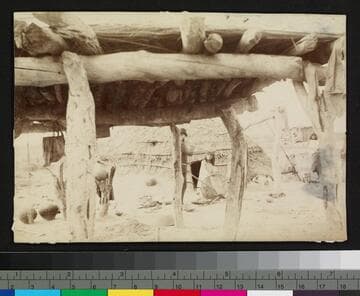
Image of a man in a bowler and suit talking to a woman, possibly Navajo, outside her hogan. Another woman can be seen in the background, far right.
photCL 215 (82)
Image not available
Visual Materials
A collection of photographs focusing on Apache and Pueblo Indians and the pueblos of Isleta, Jemez, Taos, Zuni (and dancers), Laguna, and Walpi, ca. 1880s-1890s. There are also early views of Albuquerque and Santa Fe in New Mexico, and Florence and Flagstaff in Arizona; unidentified towns; the Riordan Mansion; Casa Grande ruins (Arizona); cliff-dwellings; and a halfway rest station between Casa Grande and Florence. Mohave, Navajo, Maricopa, Moqui (Hopi), and Pima Indians are also represented. There are some views of digs and human remains unearthed by the Hemenway Southwestern Archaeological Expedition. Includes some photographs by Charles F. Lummis, Isaiah W. Taber, W. Calvin Brown, and a photographer called "Sanders." Images of the Indians include studio portraits and candid field photographs, in particular, Moqui (Hopi) and Zuni Indian dances as well as groups of men on horseback. Other people pictured are Frank Granger Logan, a philanthropist who funded many archaeological expeditions to the Southwest, and D.B. Robinson, an Arizona businessman. Also included is an unidentified newspaper clipping that reports on the Hemenway Southwestern Archaeological Expedition. Research has shown this article to have been published January 1888. Several photos are marked "Sellers" on the reverse, but it is unclear who this refers to. Photographs that have "Sellers" written on their versos are grouped in Folder 5. Copy negatives have been made for photographs (8), (12), (45), (149), and (162).
photCL 215
Visual Materials
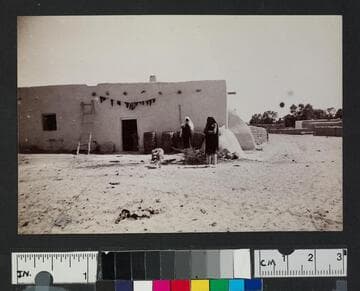
Unidentified scene, most likely a pueblo in New Mexico.
photCL 215 (181)
Image not available
Visual Materials
Photograph collection of prints and albums detailing the missionary work of William H. Weinland (1861-1930), a Moravian missionary, as well as his family and associates. Images include sites in Alaska among the Eskimo and southern California at the Morongo Reservation. Other images are from Arizona, possibly Montana, and the Great Plains. Photographs in Alaska are by Canadian missionary and Weinland associate Henry Hartmann, William H. Weinland, and commercial photographer M. Lorenz. Many of the southern California images are by William Weinland. Includes a cyanotype of native American school children in southern California and contact prints of Banning, Calif. and the surrounding area.
photCL 39
Image not available
Visual Materials
A collection of photographs and postcards focusing on Navajo and Hopi Indians and various Indian schools and schoolchildren throughout Arizona, mostly dating from the 1920s, and compiled by Los Angeles teacher and journalist Sigurd Russell. There are views of Peach Springs Trading Post, the Cameron Suspension Bridge trading post, missions at Chinle and Lukachukai (Arizona), Navajo family groups, Navajo schools at Tuba City and Oraibi (Arizona), and Navajo school crafts fairs and exhibits. Acoma, Apache, Tohono O'odham (Papago), and Hualapai Indians are also represented. The photographs were taken from 1890 to 1927, but the bulk of the collection was created during the 1920s. Includes some photographs by George Wharton James, E.E. Hall, and Burton Frasher (Frasher Fotos) . These images of Indians were taken as both posed and candid field photographs, in particular of young Navajo schoolchildren during class time and outside of school. Other subjects pictured are L.H. McSparron, owner of Thunderbird Ranch and acting custodian of Canyon de Chelly; Father Leopold Ostermann, the founder of the mission at Chinle; possibly John Lorenzo Hubbell Jr., of the Hubbell trading family; an Indian all-boys track-and-field team at an unidentified school; Indian schoolchildren; and nature views throughout Arizona. Russell also collected postcards with images of Southwest Indians, with some cards having correspondence from Russell, addressed to Beatrice Madelleine, Mrs. George R. Simmons, and Madeleine Touchaux (Russell's wife), describing how travel conditions were as well as opinions on the Indians that were encountered.
photCL 399