Opening Hours
Daily: 10 A.M.–5 P.M.
Closed on Tuesdays
1151 Oxford Road
San Marino, CA 91108
Daily: 10 A.M.–5 P.M.
Closed on Tuesdays
1151 Oxford Road
San Marino, CA 91108

Visual Materials
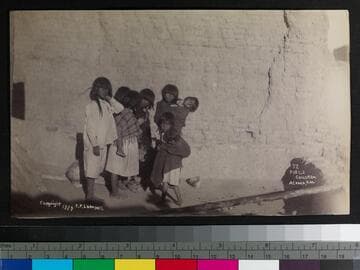
Image of eight children in a group, some being carried on the backs of others, in front of an adobe wall.
photCL 215 (70)
Image not available
Rare Books
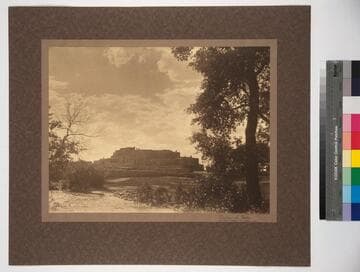
"When Taos Pueblo, his first book, was published in 1930, Ansel Adams was just 28 ... Adams had only recently put aside a nascent career as a concert pianist to pursue photography full time, but he still wasn't sure he could make a go of it when he took up the Taos project in collaboration with Mary Austin, a popular novelist and nature writer based in Santa Fe. ... The twelve photos in Taos Pueblo--each an original print on silver bromide paper prepared especially for the book by Adam's San Francisco custom-paper supplier, William Dassonville--include several formal portraits reminiscent of Edward Curtis and nearly circumscribed, almost intimate landscapes that are a far cry from the inflated magnificence associated with Adam's later work. ... The book's solid success at the height of the Depression (all 108 copies sold over two years at $75 a piece) encouraged Adams to continue in his course as a photographer of the American landscape."--The Book of 101 Books : Seminal Photographic Books of the Twentieth Century / Edited by Andrew Roth. New York : PPP Editions in association with Ruth Horowitz, 2001.
645235
Visual Materials
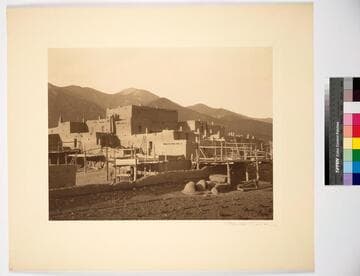
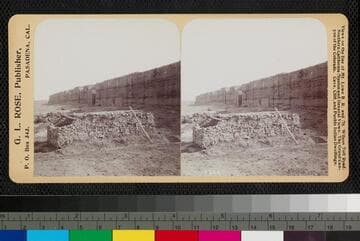
View of pueblo buildings and ovens at Taos.
photCL 312
Visual Materials
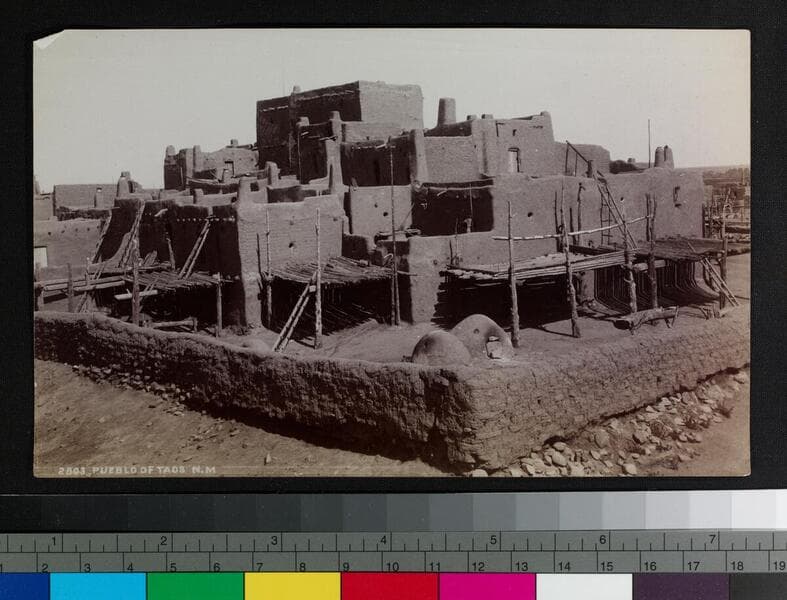
Long and tall adobe wall surrounding the village.
photCL 294 (97)
Image not available
Visual Materials
This collection of photographs documents Native Americans living in Arizona, New Mexico and Oklahoma between 1904 and 1917. The primary tribes represented are Hopi, Navajo and Taos Pueblo Indians, but there are also Osage, Apache and several other Southwestern tribes. There are many portraits, as well as posed, romantic scenes depicting storytelling, hunting, weaving, or playing instruments. Additional candid views show people in their daily activities, pueblos, and dance ceremonies. In a letter to Henry Huntington, Feb. 12, 1923, Moon describes these photographs as "a complete collection of my Indian pictures made from the beginning of my work in 1904 to 1917. It includes ... the pick of the Fred Harvey collection that I made for them during the period of my contract with them, 1907 to 1914, and my own collection made since the latter date." Besides the portraits, there are scenes of Indians in their daily activities, including baking bread in outdoor ovens, gathering water in pots, riding horses and tending livestock. There are also views of the Hopi Snake Dance, and the Corn Dance at Santo Domingo.
photCL 313