Visual Materials
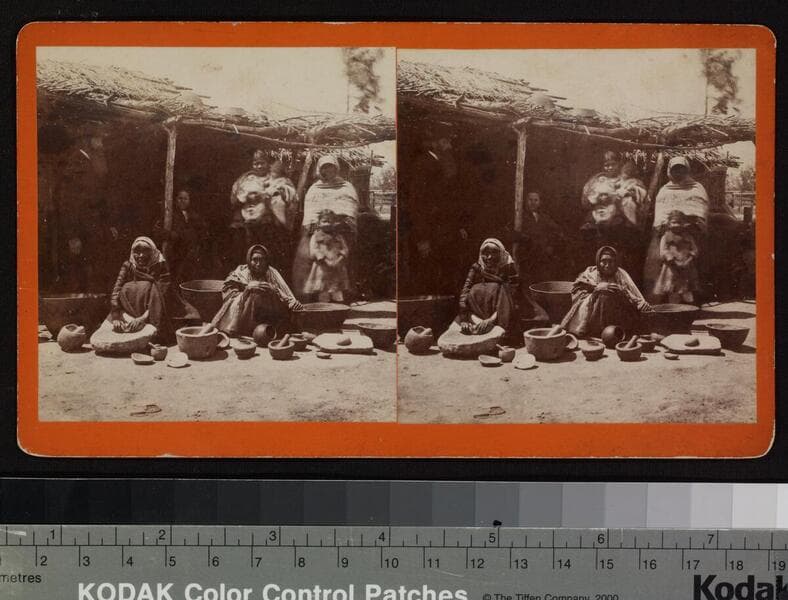
Four generations of Mission Indians, San Gabriel, California
1 of 2
Visual Materials
Daily: 10 A.M.–5 P.M.
Closed on Tuesdays
1151 Oxford Road
San Marino, CA 91108


Visual Materials
Horatio Rust (far left) and Indian women and children standing in a brush shelter. In the foreground are stone mortar and pestle; pottery.
photPF 25710
Visual Materials
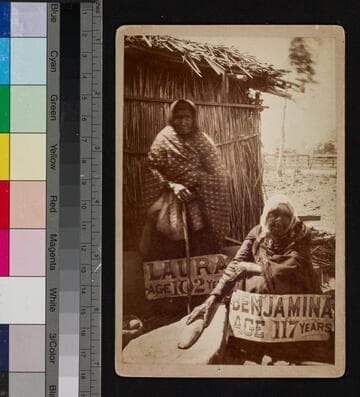
Two Indian women outside a brush dwelling. One woman holds a pestle on a stone mortar. The women have signs in front of them with the names Laura, age 102 years, and Benjamina, age 117 years.
photPF 20857
Visual Materials
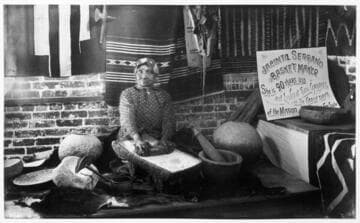
Indian woman seated with a variety of tools, pottery, baskets, and blankets.
photCL Pierce 02716
Visual Materials
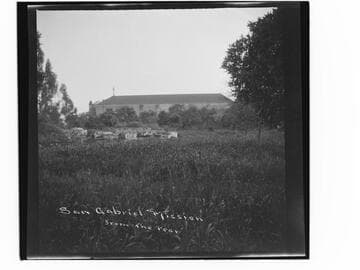
View of the rear of Mission San Gabriel Arcangel in San Gabriel, California, with trees, a field, and stone ruins in the foreground.
photCL_555_06_126
Image not available
Visual Materials
A collection of photographs and lantern slides compiled by Horatio Nelson Rust (1828-1906), a U.S. Indian agent and artifact collector in California in the late 19th century. The disbound photograph album in Boxes 1 and 2 include many views of Indian artifacts, such as arrowheads, pottery, metal and stone relics, some of which were excavated by Rust himself, as he describes in captions. There are also views of skulls excavated in Missouri, 1879, by Rust. Rust's handwritten captions identifying items and where they were found, by himself or others, are of particular interest in this collection. The album also contains photographs of Indians from Great Plains and western tribes, and Indian schools in Tahlequah, Oklahoma, and Perris, California. There are two striking "before and after" photographs of Chiricahua Apache children sent to Carlisle Indian School, Pennsylvania. Also of note are many views of Southern California Indians, including portraits of Cabazon, Soboba, Luiseno and Cahuilla tribe members, some partially identified by family names: Estudillo; Victoriano of Soboba; Lugo (or Lubo); Casero; Costo; Pablo "Chief of Cahuilla"; Silvestre. Other subjects included: two group portraits of Yuma Indian men, 1891; studio portraits of Keokuk (Sauk); Billy Bowlegs (Seminole); Ouray and Ignacio (Ute); reproductions of drawings of Indians on horses; reproductions of 17th-century deeds related to John Pynchon and colonial Deerfield, Massachusetts; a John K. Hillers photograph of John W. Powell, George W. Ingalls and others in Colorado, 1873; scenes of the Indian Council at Pala, California, 1886; Old Creek Indian Council House, Okmulgee, OK; and portraits of Sam Temple and the Cahuilla woman known as "Ramona," who inspired characters in Helen Hunt Jackson's novel, Ramona. Photographs in Box 3 include views of: Trinity River and vicinity, Northern California, approximately 1880s; camping; scenery; Indian workers standing outside agency; trading post; railroad station in Holbrook, Arizona; missions in California and Tucson, Arizona; Southwest Indians; portrait of Otis T. Mason; archaeological specimens; H. N. Rust family members. Most of the lantern slides in Boxes 4-7 are copies of photographs elsewhere in the Rust Collection, such as: Southwest Pueblo views by John K. Hillers (photCL 10); Rust's trip to Arizona, 1895, with A. C. Vroman (photCL 8). Topics of other slides: Southwest Indians by photographer Frederick H. Maude; San Gabriel Mission; two views of H. N. Rust's home; Aztec artifacts and ruins.
Image not available
Visual Materials
A photograph album compiled by Horatio Nelson Rust (1828-1906), U.S. Indian agent and archaeological artifact collector, documenting Indians living in Southern California, Arizona and New Mexico, approximately 1886-1905. Includes group portraits of Indian school students in California; members of the Cahuilla, Luiseno, Morongo, Mojave, Hopi, and Navajo tribes; the Indian Council at Pala, 1886; and scenes in Pechanga, Soboba and other native communities of Southern California. A smaller portion of the album includes Southwest and pueblo scenes; archaeological artifacts; and a few commercial photographs of North American Indians from elsewhere. Some notable images include: a snapshot of Chief Joseph and his nephew standing in front of a train, 1898; views of Navajo Indians whom Rust brought to Pasadena, San Pedro and the Pacific Ocean, 1902-03; and Indian agent Tom Jeffords. Rust appears in several photographs throughout the album. The photographs were made by various photographers, mostly unidentified, but some are credited: C. J. Crandall; E. A. Bonine; C. S. Fly (reproductions of photographs of Geronimo); and John Grabill. The album is accompanied by a four-page index by Rust and a few pieces of ephemera, including a printed card of "The Lord's Prayer translated by William E. Connelley into the Wyandot language."
photCL 7
photCL 11