Visual Materials
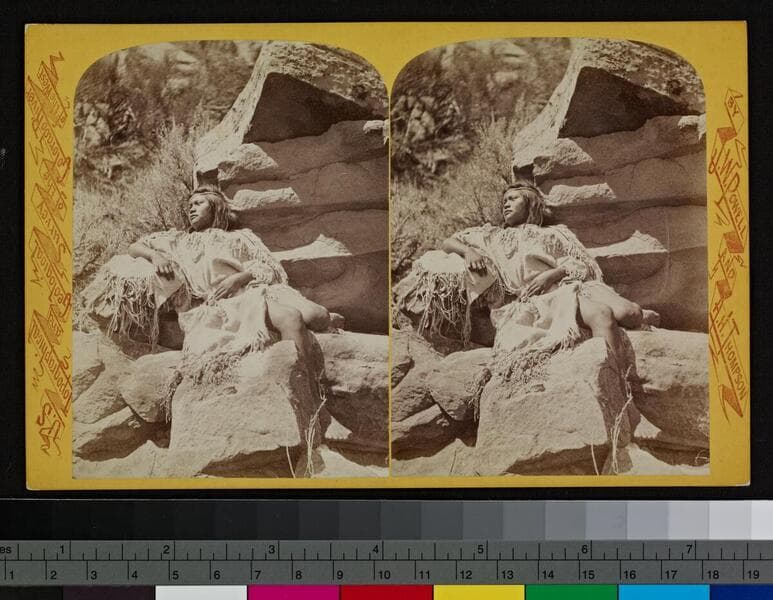
Won-sí-vu at Rest
1 of 2
Daily: 10 A.M.–5 P.M.
Closed on Tuesdays
1151 Oxford Road
San Marino, CA 91108

Visual Materials
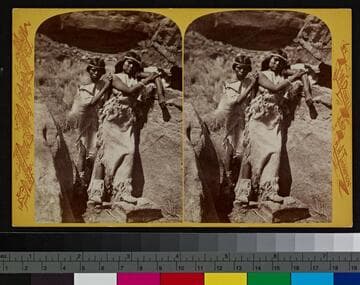
Two Paiute girls in native dress, leaning against rock.
photPF 3688
Visual Materials
Image of a progressive proof book showing the color ink layers for a print of a girl standing in a forest wearing a flower crown and leaning against a rocky outcropping; she holds a hat in her hands.
priJLC_PRG_004432
![[Young woman leaning on fence with child tugging on her dress]](/_next/image?url=https%3A%2F%2Frail.huntington.org%2FIIIF3%2FImage%2F22APN4E3XOSY%2Ffull%2F%5E360%2C%2F0%2Fdefault.jpg&w=750&q=75)
Visual Materials
Image of a young woman with brown hair wearing a red ribbon around her waist leaning against a fence while a little blond girl in a pink dress tugs at her skirt in a country setting with trees, rocks, and flowers.
priJLC_ENT_000987
Image not available
Visual Materials
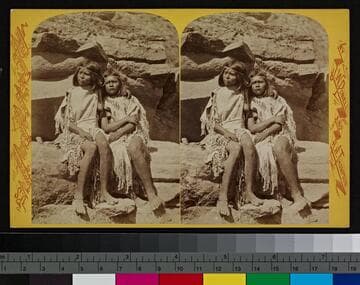
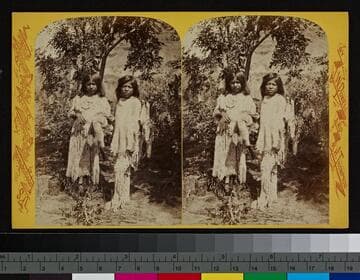
The collection contains 106 stereographs depicting the U.S. Topographical and Geological Survey of the Colorado River of the West (1871-1874), which was sponsored by the U.S. Geological Survey and conducted by J.W. Powell and A.H. Thompson. Most of the photographs are credited with John Karl Hillers, however images were also produced by E.O. Beamon and James Fennemore. The expedition series covers the southwestern Wyoming territory, the southern and northeast corner of Utah (Wasatch Mountains and Uinta Valley), southern Nevada, northern Arizona, and northern New Mexico. Various Indigenous tribal nations were photographed during the expedition and documented using phonetic spellings captured in the titles; the Kai-vav-its (Kaibab Band of Paiutes), The Uintah, Moapa Band of Paiutes, Hopi (Oraibi, Third mesa of the Hopi Nation), and Nav-a-jos (the Diné, Navajo Nation). Several Indigenous persons are noted by name. Such as, Kurá-tu and Mu-pates (Kaibab Paiute girls), Won-sí-vu and Ku-rá-tu (Kaibab Paiute girls), Tau-Gu (Headman of the Southern Paiute in Arizona), E-nu-ints-i-gaip “one of the ancients” (Southwestern Nevada Paiute elder), An-te-ro (Graceful Walker) “War chief of the Uinta Utes,” Nau-no-kwits, Ku-ri-en, and Nau-no-kwits’ eagle (Uinta Ute), Ash-tish-kel “A Chief of the Navajos” (Diné), and Chu-ar-ru-um-peak and family (Piaute family near Kaibab Plateau). There are several series titles within the collection: Views on Vermillion Creek, Views on the Sevier River, Pine Creek Series, Views on the Rio Virgen (Pa-roó-nu-weap and Mu-koon-tu-weap series), Moó-av Cañon from the Paí-yu-ní Toóm-pin woo-neir, Views on the Colorado River, Grand Cañon Series, The Cañon from To-ró-weap Valley, Marble Cañon Series, Glen Cañon Series, Views on Kanab Creek, Views on Green River (Cañon of Lodore Series, Red Cañon Series, Still Water Cañon Series, Shin-ou-av Too-weap), Views on Ashley’s Creek (tributary on Green River or Tswan-war-nav-its), Views on Brush Creek (Ka-shu-Nu-kwint), Cataract Cañon Series, Indians of the Colorado Valley Series, and Cañon of Desolation series.
photPF 3600-3713