Opening Hours
Daily: 10 A.M.–5 P.M.
Closed on Tuesdays
1151 Oxford Road
San Marino, CA 91108
Daily: 10 A.M.–5 P.M.
Closed on Tuesdays
1151 Oxford Road
San Marino, CA 91108
Image not available
Manuscripts
Railroadiana (Western U.S.A), Part 1 is composed mainly of material concerning court cases related to the Central Pacific, Southern Pacific, California Pacific, California Pacific Extension, Northern, and Western Pacific railroad companies. Most of the material in the collection relates to Central Pacific Railroad Company v. Alfred Andrew Cohen (1876), as the transcript of the case is contained in 14 volumes.
mssRR1
Image not available
Rare Books
This collection consists of railroad photographs, ephemera and publications, 1829-2010, with the bulk of material from the early- to mid-20th century. The focus is chiefly locomotives and trains (steam and diesel) of major railroads and interurban electric railways of the United States and Canada. Also represented in the collection are smaller shortline and narrow-gauge railroads; other foreign railroads; streetcars (or trolleys); and burgeoning light rail and subway systems. Most of the ephemera is printed material produced by railroad companies for promotional and business purposes, such as annual reports, brochures, route maps and guides, timetables, tickets, dining menus, stationery, stock certificates, bond coupons and other items. There are also many city and state tourist guidebooks describing sights along rail routes or promoting land available for farming, mining or home-building across the United States. Also included are items produced for or by railroad employees, such as instruction and safety manuals, train orders, freight bills and in-house newsletters. Railroad industry publications, statistics and reports can be found in the American Association of Railroads files, which are part of Donald Duke's subject files on railroad-related topics. Throughout the ephemera files are newspaper and journal clippings, often from scarce small press and trade publications such as The Railway and Engineering Review, The Railroad Gazette, The Santa Fe Magazine, The Western Railroader, Railway Age and others. In addition to railroad history, other topics of social and cultural historical interest in the ephemera are: Depictions of African Americans and Native Americans in mass-marketed train travel brochures. There are many examples that reflect American cultural and class stereotypes in the early- to mid-20th century. Selected files are noted in the container list. Occupational safety and health: See railroad worker safety manuals and accident prevention literature in ephemera files. History of food and drink: See numerous dining and beverage menus throughout Railroads and Foreign Railroads ephemera files (not always noted in container list). History of graphic design and typography: See examples of early- and mid- 20th century popular styles in printed ephemera throughout collection. Photographs and negatives: The photographs depict locomotives, freight and passenger trains, logging railroads, electric interurbans and streetcars across the United States. This was primarily a publishers file of ready-for-press photographs, which are almost all 8 x 10-inch black-and-white prints, made approximately 1950s-1980s. The photographs were made chiefly by various amateur train photographers, including Donald Duke, but most are uncredited. There are some copy prints (photographs of other photographs), and a few original photographs from the late 19th-early 20th century. Some photographs have locations and dates written on the back, but many are unidentified other than the name of the railroad. There are a few files on Ward Kimball (1914-2002), one of the original animators for Walt Disney Studios and an avid rail enthusiast. There are some photographs, biographical materials, and a file on his personal backyard narrow-gauge steam railroad, Grizzly Flats Railroad, in San Gabriel, California.
645950
Image not available
Rare Books
This collection consists of railroad photographs, ephemera and publications, 1829-2010, with the bulk of material from the early- to mid-20th century. The focus is chiefly locomotives and trains (steam and diesel) of major railroads and interurban electric railways of the United States and Canada. Also represented in the collection are smaller shortline and narrow-gauge railroads; other foreign railroads; streetcars (or trolleys); and burgeoning light rail and subway systems. Most of the ephemera is printed material produced by railroad companies for promotional and business purposes, such as annual reports, brochures, route maps and guides, timetables, tickets, dining menus, stationery, stock certificates, bond coupons and other items. There are also many city and state tourist guidebooks describing sights along rail routes or promoting land available for farming, mining or home-building across the United States. Also included are items produced for or by railroad employees, such as instruction and safety manuals, train orders, freight bills and in-house newsletters. Railroad industry publications, statistics and reports can be found in the American Association of Railroads files, which are part of Donald Duke's subject files on railroad-related topics. Throughout the ephemera files are newspaper and journal clippings, often from scarce small press and trade publications such as The Railway and Engineering Review, The Railroad Gazette, The Santa Fe Magazine, The Western Railroader, Railway Age and others. In addition to railroad history, other topics of social and cultural historical interest in the ephemera are: Depictions of African Americans and Native Americans in mass-marketed train travel brochures. There are many examples that reflect American cultural and class stereotypes in the early- to mid-20th century. Selected files are noted in the container list. Occupational safety and health: See railroad worker safety manuals and accident prevention literature in ephemera files. History of food and drink: See numerous dining and beverage menus throughout Railroads and Foreign Railroads ephemera files (not always noted in container list). History of graphic design and typography: See examples of early- and mid- 20th century popular styles in printed ephemera throughout collection. Photographs and negatives: The photographs depict locomotives, freight and passenger trains, logging railroads, electric interurbans and streetcars across the United States. This was primarily a publishers file of ready-for-press photographs, which are almost all 8 x 10-inch black-and-white prints, made approximately 1950s-1980s. The photographs were made chiefly by various amateur train photographers, including Donald Duke, but most are uncredited. There are some copy prints (photographs of other photographs), and a few original photographs from the late 19th-early 20th century. Some photographs have locations and dates written on the back, but many are unidentified other than the name of the railroad. There are a few files on Ward Kimball (1914-2002), one of the original animators for Walt Disney Studios and an avid rail enthusiast. There are some photographs, biographical materials, and a file on his personal backyard narrow-gauge steam railroad, Grizzly Flats Railroad, in San Gabriel, California.
Image not available
Rare Books
Unique among American novels for its epic scope and panoramic social sweep, John Dos Passos' U.S.A. has long been acknowledged as a monument of modern fiction. In the novels that make up the trilogy -- The 42nd Parallel (1930), 1919 (1932), and The Big Money (1936) -- Dos Passos creates a collective portrait of America in the first three decades of the 20th century, shot through with sardonic comedy and social observation. He interweaves the careers of his characters and the events of their time with a narrative verve and technical skill that make U.S.A. among the most compulsively readable of modern classics. In his prologue, Dos Passos writes: "U.S.A. is the slice of a continent. U.S.A. is a group of holding companies, some aggregations of trade unions, a set of laws bound in calf, a radio network, a chain of moving picture theatres, a column of stock quotations rubbed out and written in by a Western Union boy on a blackboard, a public library full of old newspapers and dogeared history books with protests scrawled on the margins in pencil ... But mostly U.S.A. is the speech of the people." The trilogy is filled with American speech: labor radicals and advertising executives, sailors and stenographers, interior decorators and movie stars. This edition also contains newly researched chronologies of Dos Passos' life and of world events cited in U.S.A., notes, and an essay on textual selection.
660876
Image not available
Rare Books
This collection consists of railroad photographs, ephemera and publications, 1829-2010, with the bulk of material from the early- to mid-20th century. The focus is chiefly locomotives and trains (steam and diesel) of major railroads and interurban electric railways of the United States and Canada. Also represented in the collection are smaller shortline and narrow-gauge railroads; other foreign railroads; streetcars (or trolleys); and burgeoning light rail and subway systems. Most of the ephemera is printed material produced by railroad companies for promotional and business purposes, such as annual reports, brochures, route maps and guides, timetables, tickets, dining menus, stationery, stock certificates, bond coupons and other items. There are also many city and state tourist guidebooks describing sights along rail routes or promoting land available for farming, mining or home-building across the United States. Also included are items produced for or by railroad employees, such as instruction and safety manuals, train orders, freight bills and in-house newsletters. Railroad industry publications, statistics and reports can be found in the American Association of Railroads files, which are part of Donald Duke's subject files on railroad-related topics. Throughout the ephemera files are newspaper and journal clippings, often from scarce small press and trade publications such as The Railway and Engineering Review, The Railroad Gazette, The Santa Fe Magazine, The Western Railroader, Railway Age and others. In addition to railroad history, other topics of social and cultural historical interest in the ephemera are: Depictions of African Americans and Native Americans in mass-marketed train travel brochures. There are many examples that reflect American cultural and class stereotypes in the early- to mid-20th century. Selected files are noted in the container list. Occupational safety and health: See railroad worker safety manuals and accident prevention literature in ephemera files. History of food and drink: See numerous dining and beverage menus throughout Railroads and Foreign Railroads ephemera files (not always noted in container list). History of graphic design and typography: See examples of early- and mid- 20th century popular styles in printed ephemera throughout collection. Photographs and negatives: The photographs depict locomotives, freight and passenger trains, logging railroads, electric interurbans and streetcars across the United States. This was primarily a publishers file of ready-for-press photographs, which are almost all 8 x 10-inch black-and-white prints, made approximately 1950s-1980s. The photographs were made chiefly by various amateur train photographers, including Donald Duke, but most are uncredited. There are some copy prints (photographs of other photographs), and a few original photographs from the late 19th-early 20th century. Some photographs have locations and dates written on the back, but many are unidentified other than the name of the railroad. There are a few files on Ward Kimball (1914-2002), one of the original animators for Walt Disney Studios and an avid rail enthusiast. There are some photographs, biographical materials, and a file on his personal backyard narrow-gauge steam railroad, Grizzly Flats Railroad, in San Gabriel, California.

Visual Materials
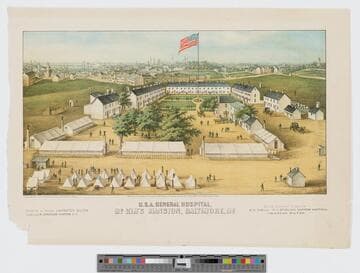
Image of the U.S.A. General Hospital located at McKim's mansion in Baltimore, Maryland, during the American Civil War; buildings and tents form a square around a central courtyard with large American flag flying on a flagpole at center; horse-drawn vehicles and soldiers at various duties outside in the area; city of Baltimore visible in background.
priJLC_MIL_003321
645950
645950