Manuscripts
(31) LIGHTNING EXPRESS, new arrangement through trains daily between Virginia and San Francisco, printed by H. S. Crocker Co. San Francisco
You might also be interested in
Image not available
Southern Pacific Railroad Company. City of San Francisco / Fastest Thing On Wheels Between Chicago and San Francisco ... [Illustration of red and orange ALCO engine no. 6015 pulling train with San Francisco in background]
Rare Books
This collection of railroad ephemera, photographs, prints and posters concerns only streamliner trains--the wind-resistant, "streamlined" designs first appearing on major U.S. railroads in 1934 and peaking in the glamour years of the American streamliner, late 1930s to 1955. The sleek, fast trains were promoted for their speed, luxury and comfort compared to older, heavyweight steam locomotives. The bulk of the collection is composed of passenger brochures, with especially extensive files on Union Pacific; Southern Pacific; New York Central; Chicago, Burlington and Quincy ("the Burlington"); and the Atchison, Topeka and Santa Fe ("the Santa Fe") railroads. There are also many materials on Amtrak (formed in 1971), and foreign railroads, particularly in Canada, Europe and Japan. Besides brochures, other printed materials include: manufacturer's pamphlets, employee newsletters, press releases, blueprints of railcars, copies of U.S. Patent Office design applications, menus, lounge car stationery, baggage stickers and other items. The photographs are mostly railroad-issued 8 x 10-inch prints showing train exteriors and richly designed dining cars, lounge cars, sleeping cabins and domed observation cars. There are also many high-quality small-format photographs made by Leslie Merrill and other amateur photographers, 1938 to 1960s. The prints and posters mostly consist of promotions for U.S. railroads, with several notable pre-World War II posters for European railroads. An important section of the collection covers early streamlining experiments of the late-19th century: Samuel R. Calthrop's "air-resisting" train of 1865; Frederick U. Adams's "Windsplitter" of 1893; Joe V. Meigs' "Meigs Elevated Railway" monorail in 1880s Boston; and William Riley McKeen Jr.'s aerodynamic McKeen Motor Car of the 1900s. In addition to railroad history, other topics of social and cultural historical interest are: Depictions of African Americans and Native Americans in mass-marketed train travel brochures. There are many examples that reflect American cultural and class stereotypes in the early- to mid-20th century. History of food and drink: See numerous dining car and beverage menus (not always noted in container list). History of advertising, graphic design and typography represented in 20th-century railroad print advertising.
646607_119
Image not available
Ireland: C.I.É. [Córas Iompair Éireann]. New Inter-City Express Trains between Galway and Dublin … [Illustration of interurban train]
Rare Books
This collection of railroad ephemera, photographs, prints and posters concerns only streamliner trains--the wind-resistant, "streamlined" designs first appearing on major U.S. railroads in 1934 and peaking in the glamour years of the American streamliner, late 1930s to 1955. The sleek, fast trains were promoted for their speed, luxury and comfort compared to older, heavyweight steam locomotives. The bulk of the collection is composed of passenger brochures, with especially extensive files on Union Pacific; Southern Pacific; New York Central; Chicago, Burlington and Quincy ("the Burlington"); and the Atchison, Topeka and Santa Fe ("the Santa Fe") railroads. There are also many materials on Amtrak (formed in 1971), and foreign railroads, particularly in Canada, Europe and Japan. Besides brochures, other printed materials include: manufacturer's pamphlets, employee newsletters, press releases, blueprints of railcars, copies of U.S. Patent Office design applications, menus, lounge car stationery, baggage stickers and other items. The photographs are mostly railroad-issued 8 x 10-inch prints showing train exteriors and richly designed dining cars, lounge cars, sleeping cabins and domed observation cars. There are also many high-quality small-format photographs made by Leslie Merrill and other amateur photographers, 1938 to 1960s. The prints and posters mostly consist of promotions for U.S. railroads, with several notable pre-World War II posters for European railroads. An important section of the collection covers early streamlining experiments of the late-19th century: Samuel R. Calthrop's "air-resisting" train of 1865; Frederick U. Adams's "Windsplitter" of 1893; Joe V. Meigs' "Meigs Elevated Railway" monorail in 1880s Boston; and William Riley McKeen Jr.'s aerodynamic McKeen Motor Car of the 1900s. In addition to railroad history, other topics of social and cultural historical interest are: Depictions of African Americans and Native Americans in mass-marketed train travel brochures. There are many examples that reflect American cultural and class stereotypes in the early- to mid-20th century. History of food and drink: See numerous dining car and beverage menus (not always noted in container list). History of advertising, graphic design and typography represented in 20th-century railroad print advertising.
646607_46
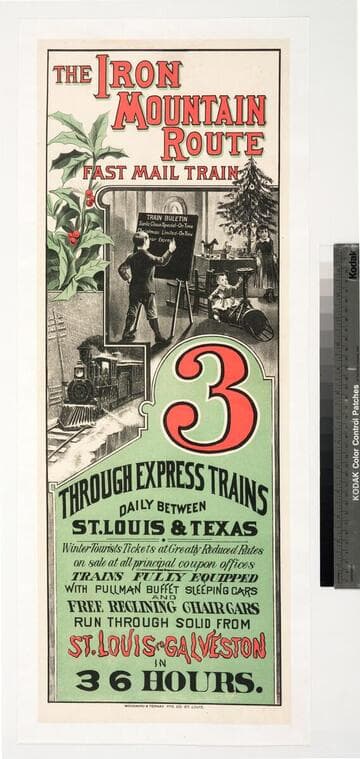
The iron mountain route fast mail train : 3 through express trains daily between St. Louis & Texas
Visual Materials
Image of a poster advertising the Iron Mountain Route of the Missouri Pacific Railroad with a lithographed vignette in the upper right of three children in a room decorated with a Christmas tree, with one boy writing the names of three Christmas trains on a folded blackboard and an infant pretending to drive a locomotive made of furniture; second lithographed vignette in the middle left of a perspective view of a steam locomotive on tracks in a winter scene; background ornamented with sprig of holly.
priJLC_TRAN_001109
Image not available
Chicago and North Western Railway Company. World's Finest Fleet of Trains / Streamliners / City of Denver fastest long distance train / 16 hours between Chicago and Colorado - Daily / City of Los Angeles / City of San Francisco / City of Portland … [Illustration of streamliners]
Rare Books
This collection of railroad ephemera, photographs, prints and posters concerns only streamliner trains--the wind-resistant, "streamlined" designs first appearing on major U.S. railroads in 1934 and peaking in the glamour years of the American streamliner, late 1930s to 1955. The sleek, fast trains were promoted for their speed, luxury and comfort compared to older, heavyweight steam locomotives. The bulk of the collection is composed of passenger brochures, with especially extensive files on Union Pacific; Southern Pacific; New York Central; Chicago, Burlington and Quincy ("the Burlington"); and the Atchison, Topeka and Santa Fe ("the Santa Fe") railroads. There are also many materials on Amtrak (formed in 1971), and foreign railroads, particularly in Canada, Europe and Japan. Besides brochures, other printed materials include: manufacturer's pamphlets, employee newsletters, press releases, blueprints of railcars, copies of U.S. Patent Office design applications, menus, lounge car stationery, baggage stickers and other items. The photographs are mostly railroad-issued 8 x 10-inch prints showing train exteriors and richly designed dining cars, lounge cars, sleeping cabins and domed observation cars. There are also many high-quality small-format photographs made by Leslie Merrill and other amateur photographers, 1938 to 1960s. The prints and posters mostly consist of promotions for U.S. railroads, with several notable pre-World War II posters for European railroads. An important section of the collection covers early streamlining experiments of the late-19th century: Samuel R. Calthrop's "air-resisting" train of 1865; Frederick U. Adams's "Windsplitter" of 1893; Joe V. Meigs' "Meigs Elevated Railway" monorail in 1880s Boston; and William Riley McKeen Jr.'s aerodynamic McKeen Motor Car of the 1900s. In addition to railroad history, other topics of social and cultural historical interest are: Depictions of African Americans and Native Americans in mass-marketed train travel brochures. There are many examples that reflect American cultural and class stereotypes in the early- to mid-20th century. History of food and drink: See numerous dining car and beverage menus (not always noted in container list). History of advertising, graphic design and typography represented in 20th-century railroad print advertising.
646607_11
Image not available
(a) Correspondence relative to the charter of the last special train and the last passenger train (as distinct froma mixed train) to operate over the railroad, on
Manuscripts
The collection consists of materials related to railroads built in Nevada and eastern California in connection with the Comstock Lode in Virginia City, Nevada, and other mining booms in Nevada and California (mainly in the period from 1870-1890). Subjects in the collection include not only the railroad and mining industries but also the lumber industry.
mssNevadar
Image not available
Virginia & Truckee R.R. and Virginia & Truckee Ry. companies
Manuscripts
The collection consists of materials related to railroads built in Nevada and eastern California in connection with the Comstock Lode in Virginia City, Nevada, and other mining booms in Nevada and California (mainly in the period from 1870-1890). Subjects in the collection include not only the railroad and mining industries but also the lumber industry.
mssNevadar