Opening Hours
Daily: 10 A.M.–5 P.M.
Closed on Tuesdays
1151 Oxford Road
San Marino, CA 91108
Daily: 10 A.M.–5 P.M.
Closed on Tuesdays
1151 Oxford Road
San Marino, CA 91108

Image not available
Manuscripts
Mrs. H. H. Dayton kept this diary while traveling with her husband, Nate, and Mr. and Mrs. Ben H. Van Levy in 1909. The diary begins in September 1909 with the couples leaving and traveling to Minneapolis, St. Paul, Banff, Winnipeg, Vancouver, Victoria, Seattle, Portland, and then south to California. Mrs. Dayton spends 12 pages describing her experiences in San Francisco: the aftermath of the 1906 earthquake; Golden Gate Park; Cliff House; Chinatown; as well as a visit to an opium den. The diary ends after the couples traveled back to the east coast, arriving home in October 1909. The diary also contains several lists: hotels; cities visited; railroads traveled; theaters attended; miles traveled; and states crossed. The names of the travelers are inside the front cover.
mssHM 81272
Image not available
Manuscripts
The diary only contains one month of entries. In the diary Dunn talks about his experience of living in a mining camp near Weaverville. He talks in detail about snow storms that caused the roofs of buildings to cave in and rain that caused floods; his fellow miners, including one man who got drunk and was later found dead in the snow; prices of provisions such as beef, pork, flour, barley, and potatoes; a New Year's ball held at the Independence Hotel in Weaverville; and problems with competing miners in Stewart's Flat.
mssHM 67919
Manuscripts
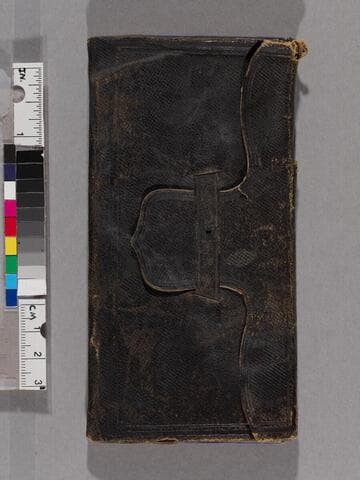
Pocket diary in pencil and pen. Describes the brief period of four months while Thomas was in the 4th Iowa Cavalry Regiment, Company E, prior to his falling ill and dying in May of 1864. Includes his comments on falling sick and fighting the "flux."
mssHM 76855
Image not available
Manuscripts
Mary Arbeely wrote this diary during the final months of the family's Beirut trip (1908, November 17-1909, September 30).
mssHM 83424
Manuscripts
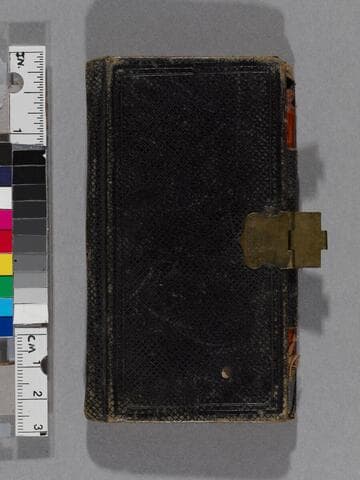
Pocket diary in pencil and pen. Covers a wide range of dates, and includes address, muster lists, as well as diary entries for the Months of August, September and October, 1863. There is a drawing of a dove on the inside back cover.
mssHM 76851
Image not available
Manuscripts
Diary that Davidson kept from June 1840 to the end February 1840, most of which Davidson spent serving onboard the Dale on her maiden voyage to South America. As he sailed from Norfolk to Brazil and around Cape Horn, Davidson meticulously recorded every detail of his duties -- setting sails; logging distance, coordinates, and winds; supervising the crew, etc. The richly detailed diary reveals a young, enthusiastic sailor, endowed with a keen eye, natural curiosity, and a certain literary talent. (His younger sister Virginia Emeline Davidson later became a well known writer.) The diary provides an intimate look at the life of midshipmen ("Middies") and their often complicated relationship with the officers and crew. Davidson described in great detail numerous encounters with British, Danish, French, Peruvian, and American whalers and naval vessels. The latter included the famed frigates Constellation and Constitution. Throughout the voyage, Davidson used every opportunity to go ashore, recording his impressions, paying particular attention to local population, especially the ladies. While in Guayaquil, the Dale was paid a visit by Andres de Santa Cruz y Calahumana, the exiled Marshall of Peru-Bolivian Confederacy. Davidson reported the visit in great detail.
mssHM 69950