Skip to content

OPEN TODAY: 10 A.M.–5 P.M.

Manuscripts

Amelia Osborne & her Baby: original pencil drawing

Image not available


You might also be interested in

  • Image not available

    Original pencil and watercolor sketches

    Manuscripts

    Includes 34 drawings, and two letters.

    mssHM 40005

  • Image not available

    Original pencil, pen and ink, and watercolor sketches

    Manuscripts

    Includes 32 drawings, and two letters (1902).

    mssHM 40004

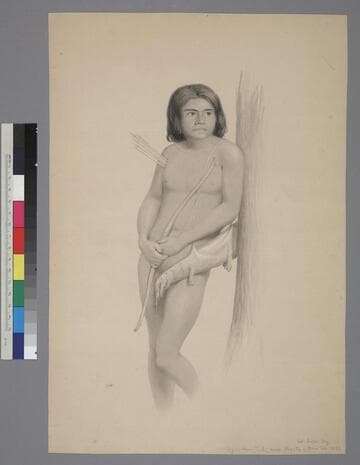
  • Drawings of Henry B. Brown, 1851-1852

    Drawings of Henry B. Brown, 1851-1852

    Manuscripts

    This collection contains pencil drawings drawn in 1851 and 1852 by American artist, and later United States Consul to Bermuda, Henry B. Brown. The forty-two drawings are arranged according to their five general subjects: California Native Americans (7), California landscapes (24), Mexico (4), Central America (6), and Other (1). Although the exact Indian tribes in Brown's drawings are not known, it is believed that they are the Maidu, Nomlaki, Patwin, Wintun, and/or the Shasta Indians because those tribes lived in the areas in California where Brown was traveling. These drawings include portraits of Indians and scenes of daily life in Indian villages. Five of these drawings have been published in Drawn from Life: California Indians in Pen and Brush by Theodora Kroeber, Albert B. Elsasser, and Robert F. Heizer, and Personal Narrative of Explorations and Incidents in Texas, New Mexico, California, Sonora, and Chihuahua by John Russell Bartlett. The twenty-four drawings of California landscapes include views of mining camps, a quartz mill, San Francisco, Marysville, Mount Shasta, Grass Valley, the Sacramento River, and Nevada City. The ten drawings of Mexico and Central America include views of Acapulco, the Gulf of California, Nicaragua, Guatemala, and El Salvador. Also included in the collection is an undated drawing of the Susquehanna river in Port Deposit, Maryland, and a blank sheet of paper that was probably used as a mount for one of the drawings. The titles used are the titles supplied by the artist. Several of the drawings have sketches or inscriptions on the verso. A number of the Brown drawings have also been published in An Artist's Portfolio: the California Sketches of Henry B. Brown by Thomas C. Blackburn.

    mssHM 62464 (1-43)

  • Image not available

    The Collegiate Church of St. Andrew, Steyning [+ 1 photograph and two original pencil drawings by Betty Peake of the church]

    Manuscripts

    This collection contains the papers of English art historian Katharine Ada Esdaile (1881-1950), with the bulk of the materials relating to her research and writings on British monumental sculpture, sculptors, and church monuments from the medieval period to 19th century. Material types include personal writings, diaries, correspondence, business papers, family papers and photographs, research files and research notebooks, and miscellaneous published and unpublished materials. Notably the collection includes more than 600 chiefly pre-World War II visitor booklets and pamphlets produced locally by British churches and approximately 3500 photographs taken or collected by Esdaile of sculpture, often funerary monuments in English churches, ranging from large churches like Westminster Abbey to small rural parishes. This collection provides a resource for viewpoints on monumental sculpture in the early 20th century (for instance as represented in book reviews by Esdaile) and for information about Esdaile's experience as a woman art historian in the early 20th century. Given the broadness of Esdaile's scope, from medieval to 19th century British monumental sculpture, the collection is less useful for specific information about monuments or sculptors. In addition, many of Esdaile's attributions in her notes appear to have been based primarily on her own instincts and do not have citations. Many of Esdaile's notes are handwritten on small scraps of paper or are fragments, sometimes making the information difficult to parse. The collection is chiefly Esdaile's files, but the dates on some items (such as post-1950 booklets) indicate the collection was added to and used after her death, presumably by her son Edmund Esdaile, who also made notes on items in the collection and appears to have done the preliminary organization of the papers after Esdaile's death.

    mssEsdaile

  • Image not available

    Baldwin Family Papers

    Manuscripts

    This collection contains family correspondence and a few miscellaneous items, chiefly addressed to Joel and Ruth Barlow, Clara Baldwin Bomford, and her daughter Ruth Bomford Paine. Correspondents include Elizabeth Whitman and George William Erving (1769-1850), an American diplomat. The letters discuss the Baldwin family affairs and contain only occasional references to political affairs. Also included are a few documents and 1 manuscript poem. The collection chiefly reflects the children of Michael Baldwin (1719-1787) of New Haven, including Abraham Baldwin (1754-1807), American statesman and founder of the University of Georgia; Henry Baldwin (1780-1844), justice of the United States Supreme Court; Ruth (Baldwin) Barlow (1756-1818) and her husband, Joel Barlow (1754-1812), American poet and statesman; Clara (Baldwin) Bomford (1782-1856), wife of George Bomford (1782-1848), chief of ordnance of the army; and the descendants of George and Clara Bomford. About one-sixth of the letters are addressed to Joel and/or Ruth Barlow, 1779-1816; about one-half to Ruth's sister, Clara (Baldwin) Bomford, 1803-1855; about one-sixth to Clara's daughter, Ruth (Bomford) Paine, 1856-1891; and the remainder to others. Perhaps the collection as a whole is best described as the remnant of a family archive which has passed through a number of generations. Subject matter include Baldwin family affairs; social life in New Haven, Connecticut; the Kalorama property in Washington, D.C., purchased by the Barlows in 1807; sold to the Bomfords in 1818 and subsequently sold by them in 1846; society in Washington, D.C., from 1803 to 1815; the Barlow's social life in Paris in 1811 and 1812; and description and travel in Europe, with letters by George W. Erving describing Switzerland, Italy, and France. Includes biographical material for: Abraham Baldwin; Ruth (Baldwin) Barlow and Joel Barlow; Clara (Baldwin) Bomford and George Bomford; George William Erving; Robert and Harriet Fulton; and other members of the Baldwin family and descendants of George & Clara Bomford. Of particular note are the letters of Elizabeth Whitman to Joel Barlow; the letters of Ruth Barlow; and the extensive series of letters from George William Erving (1769-1850), American diplomat, to Clara Bomford. Erving's letters are perhaps the most substantial part of the collection and the earlier ones are particularly interesting. He never married, occupied several diplomatic posts in Europe, travelled about a good deal, and lived for many years in Paris. The letters contain nothing about his diplomatic work as such, but are full of reflections and observations on a number of subjects and some of them run to a considerable length--there is one of twenty-nine pages. In the earlier part of the collection there are references to Joel Barlow and a number of letters addressed to him, but only one document and several postscripts in his handwriting, and copies of his will and one poem. There are occasional references to political affairs, but the primary importance of the collection is for the picture it presents of the social and day-to-day life of the time, and for the information it contains about the individuals noted below. Persons represented by 3 or more pieces (Figures in square brackets indicate number of letters addressed to the individual)" Baldwin, Abraham (24 pieces, 1789-1807 [2]) Baldwin, Henry (8 pieces, 1813-1816) Baldwin, William D. (4 pieces, 1882) Barlow, Anica (Preble) (4 pieces, 1812-1855) Barlow, Joel (3 pieces, 1797-1812 (38)) Barlow, Ruth (Baldwin) (67 pieces, 1795-1816 [41]) Bishop, Victor (7 pieces, 1845-1852) Bomford, Clara (Baldwin) (21 pieces, 1811-1827 [236]) Bomford, George (7 pieces, 1844-1848 [10]) Bomford, James V. (6 pieces, 1883-1887) Bomford, Mattie (4 pieces, 1856-1883) Dall, Caroline Wells (Healey) (7 pieces, 1884-1892) Derby, Richard C. (5 pieces, 1882-1886) Erving, George William (116 pieces, 1812-1850 [1]) Eyre, Wilson (4 pieces, 1882) Gaines, Edmund Pendleton (10 pieces, 1812-1814) Lafayette, Marquis De (4 pieces, 1789-1827) Linwood, Mary (3 pieces, 1805-1812) Madison, Dolly (Payne) Todd (4 pieces, 1811-1842) Maguire, Bernard (3 pieces, 1844-1848) Marbois, Comte De (6 pieces, 1812-1814) Maulsby, A. M. (5 pieces, 1882) Moore, Margaret Jane (King), Countess Mountcashell (4 pieces, 1812) Olmstead, Lemuel G. (11 pieces, 1854-1855) Riddle, John S. (4 pieces, 1844) Seymour, Louisa (5 pieces, 1886-1891) Smith, J. B. H. (5 pieces, 1851-1856) Thornton, Anna Maria (Brodeau) (17 pieces, 1812-1855 [18]) Whitman, Elizabeth (15 pieces, 1779-1782) Williams, Helen Maria (6 pieces, 1812-1815) Some notable items include: Baldwin, Abraham. To Ruth Barlow. 1789, July 3. "These Politicians Keep Such A Talking Round My Ears, That I Cannot Write You Any More At Present." To Joel Barlow. 1791, Mar. 13. "Many Of The Atlantic Settlers Wish The Western Country Not To Be Settled, And Take All Opportunities To Throw Blocks In The Way...." Will. 1807, Mar. 1. Barlow, Joel. Will. 1797, Apr. 15. Certified Copy, Dated 1813. Barlow, Ruth (Baldwin). To Clara Bomford. 1810, Mar. 10 abd 14. Re: Clara'S Change Of Name; Mrs. Madison; Mme. Bonaparte; Napoleon'S Divorce; Etc. To Clara Bomford. 1812, Sep. Letters Describing Her Visit To Mme. De Villette. Will. 1813, Aug. 24. To Clara Bomford. 1814, Mar. 13. "...Yet The World Suppose Him [Robert Fulton] Swimming In Wealth, Whilst In Reality He Is Oppressed With Debts Which He Can Hardly Find The Means Of Meeting. How Little My Dear Clara, We Know Of Peoples Real Situations & Feelings." Bomford, Clara (Baldwin). To Anna Maria (Brodeau) Thornton. 1811, Nov. 13. Re: Paris Opera, Joel Barlow'S Presentation To The Emperor, Etc. To Anna Thornton. 1814, Dec. 11. Our [Connecticut] neighbors are mostly people of fortune or independant farmers, all delighted to see their friends & acquaintance, they call a visit from 2 in the afternoon till 9 in the evening--about 4 they have a table groaning with the weight of all the good things they can muster--chickens sausages, apple sauce, sweet meats, bread & butter cakes & pies & in the evening cider apples & nuts. Erving, George William. To Joseph Gales. 1814, Oct. 22. Re: the misinterpretation by the British press of American news. To Clara Bomford. 1819, Oct. 6-20. Re: his life in Paris; Mrs. Decatur (she is a charming woman; she was not absolutely a flame, but a little flamelet of mine many years ago, but all calculations duly made, I thought it most prudent to withdraw.); Lafayette (he is one of those in whom hope will never die, who will always see 'couleur de rose' tho affairs be as black as ink,--he thinks that good principles & a good heart is every thing,--tho a soldier he does not calculate well the power of bayonets...) To the same. 1825, Nov. 20. I am glad that you like Mr Vaughan, but I neither presume or desire that you see much of him;--tho' he is a very estimable man, perhaps more respectable (morally speaking) than ministers are in general, yet I shoud not have given him a letter to you (for this is against my rules) but that he almost compelled me to do so:-- with all Vaughans apparent simplicity & frankness, put this well into your head, that he is as thorough an Englishman as any of them; nor could they find in all England a more fit man to send to Washington; for his modesty, his want of all pretension,--his 'bonhommie' & his moderate calm manner, are the very qualities suited to our gullibility;... To the same. 1826, June 8. Monroe... demands great 'swads' of our money without even the shadow of any right at all; thinking no doubt that as the mouth of the publick purse has opened for poor Lafayette, he may as well thrust his big fist into it; before the delicate paw of Madam Decatur shall have quite exhausted it, for the sake of her future husband.... [In Washington] You live precisely in the centre, the best position for observation--look about you,--probably you will not find one man excepting your good husband, who is devoid of this mania; look at their gray or bald foreheads--laden with care; see all the younger ones--rushing--& jostling & fighting & worrying each other, their hearts full of bitterness & envy; their nights sleepless; see what a proportion leave their families, neglect their business, impair their fortunes & ruin their constitutions, for the gratification of empty vanity--called 'ambition':--for do not mistake, not one in an hundred is there to 'serve his country' as a duty. Poor Rufus King!--he has been minister & Senator, & not being able to arrive at the Presidency for which he has been struggling all his life, must needs be minister again; well he dies in the effort! Poor Monroe! he arrived by dint of perseverance, he retires, health & fortune ruined, reputation in not much better condition,--he is to be consumed by mortification! Poor Crawford! the best years of his life sacrificed, his estate & profession neglected;--all his prospects defeated,--he vegitates!--so of the rest. To the same. 1835, Mar. 18. You & I who knew so well must sympathize in the loss of that most excellent friend Mr Crawford; I have never seen in publick life anyone of such perfect & disinterested patriotism, or in private of more pure integrity. Fulton, Robert. To Joel Barlow. 1809, Mar. 1. Re: Explanation of his moving away from Kalorama; Barlow's interest in the steamboat (you had little faith in the success or profits of the boat); Barlow's financial affairs; and getting The Columbiad reviewed in London. Gaines, Edmund Pendleton. To Clara Bomford. 1812, Jan. 20. Re: death of his wife, Frances. Lafayette, Marquis de. Dinner invitation to Joel Barlow. 1789, Feb. 9. Thornton, Anna Maria (Brodeau). To Clara Bomford. 1812, Mar. 15. Re: Count Crillon. Whitman, Elizabeth. To Joel Barlow, 14 letters, 1779-1780; and one letter to Ruth Barlow, 1782. The tragic life of Elizabeth Whitman served as the basis for the popular early American novel by Hannah Webster Foster, The Coquette, or, the history of Eliza Wharton, 1797. These letters were published (inaccurately) by Mrs. Caroline Dall in The Romance of the Association..., Cambridge, 1875.

    mssBN 1-475