Manuscripts
Canterbury tales : [manuscript]
Image not available
- Description
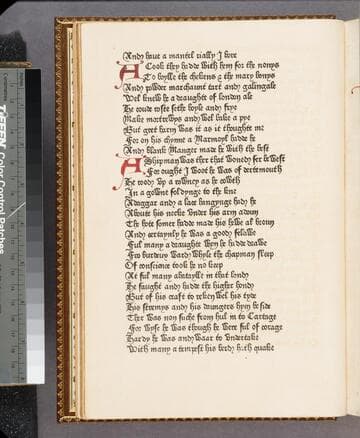
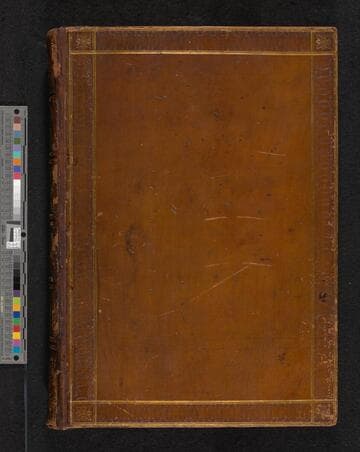
- The Ellesmere Chaucer is a beautiful and elaborately decorated manuscript of Geoffrey Chaucer's Canterbury Tales. Created between 1400 and 1410, it contains what is believed to be a portrait of Chaucer as well as miniature paintings of twenty-two of the fictional pilgrims who tell stories in order to enliven the journey from London to Canterbury. The manuscript is in excellent condition partly because it was undisturbed for about three centuries in the library of Sir Thomas Egerton (later Baron Ellesmere) and his family. See Digital Scriptorium for full description.
- Production date
- between 1400 and 1410.
- Call number
- mssEL 26 C 9
- Provenance
- Purchased with the Bridgewater library from John Francis Granville Scroop Egerton, 3rd Earl of Ellesmere, through the ageny of George D. Smith and Sotheby's of London, 1917. The poem on ff. ii verso-iv (art. 1) appears to have been written to honor the de Vere family, earls of Oxford; its inclusion in this manuscript may suggest an early association with John de Vere (1408-61/62), 12th Earl of Oxford, who after his father's death in 1417 became ward of the Duke of Exeter and in 1426 of the Duke of Bedford; both men were kinsmen of Chaucer's son, Thomas. One of the executors of the will of John de Vere (1442-1512/13), 13th Earl of Oxford, was Sir Robert Drury of Hawsted in Suffolk, 17 miles northeast of Castle Hedingham, the family seat of the de Veres. On f. i verso, s. XVI2/4, "Robertus drury miles [space], William drury miles, Robertus drury miles, domina Jarmin, domina Jarningam, dommina Alington," referring to Sir Robert Drury (mentioned above as executor; speaker of the House of Commons in 1495 and a member of Henry VIII's Council), to his sons William and Robert, and to his 3 daughters: Anna, married first to George Waldegrave, and after his death in 1528 to Sir Thomas Jermyn; Bridget, married to Sir John Jernyngham (Jernegan, of Somerleyton); Ursula (d. 1521), married to Sir Giles Alington. Among the legatees of the 13th Earl of Oxford's will were the elder Robert Drury's sons-in-law, George Waldegrave and Sir Giles Alington. On f. ii, the names "Domina Jernegan" and "Domina Jernegan, Domina Alington" are repeated; on f. i verso, "Edwarde Waldegrave" (uncle, d. 1500, or son, b. 1514, of George Waldegrave). On ff. i verso and iv verso, s. XV or XVIin, several times, the name and once the phrase, "Margery seynt John ys a shrew" (George Waldegrave had a niece, d. 1536, and a great-niece, d. 1562, by that name). On f. i verso, s. XVI, "Thomas Calthorpp of" (a Thomas Calthorpe, d. 1559, was great-nephew of the elder Sir Robert Drury's first wife, Anna, daughter of Sir William Calthorpe of Norwich). On f. ii, the initials "HD" and on f. 147v, "Henricus Drury Miles" (possibly the son of William Drury). On f. 130, s. XVI, "...per me henricum Payne" followed by a paraph, possibly referring to the Henry Payne of Nowton, near Hawsted, a member of Lincoln's Inn, d. 1568; his will shows that he had purchased lands from the Drurys; he had witnessed Sir William Drury's will in 1557 and had had a legacy from him; in his own will, he bequeathed to Sir Giles Alington, grandson of Ursula Drury and her husband Giles Alington, "the beste geldyng he will choise of eny that I haue And also my Chaucer written in vellum and illumyned with golde." On f. ii, s. XVI, "per me Thomam Badbeye," brother-in-law of Sir Ambrose Jermyn (son of the Sir Thomas Jermyn who had married Anna Drury). On ff. 64 and v recto and verso (= first back flyleaf), the name of John Hedgeman; on f. 175, the name occurs in a longer inscription, much faded, but which may read "John Hedgeman of Hawkedoun in the Countie of Suff. ? neyther squier nor knight But a knave"; Hawkedon is near the Drury seat at Hawsted and some 20 miles east of Castle Hedingham. The remaining sixteenth century ownership marks are without known connection to the de Vere or Drury families. On ff. ii verso, iii and vii verso (= third back flyleaf; erased), s. XV1, a motto, "de meuz en meuz" (de mieux en mieux?), perhaps that of the Paston family, although it seems unlikely that the book could have belonged to them at that date. On ff. ii, 229v, both times upside down, "Rycher Challes." On ff. 48, 108, "...Eilliam Sayer." On f. 48, "John Neue de oxenborowe in comt. norff. salutem percipe quod et cetera," "Rog?se Smith [?]," and a note about Thomas, Duke of Norfolk (d. 1572). On f. 54, "Thome R?dell?nold Gregorye Nycholas Arnold." On f. 169v, "Willem?te detho [?]." On f. vi (= second back flyleaf), "Thomas Newman yeve these with my hartie comendacions ?." On f. vi verso (= second back flyleaf), "...Edmond Bedingfelde esquier ? at Wightoun ?." The sixteenth century notes in the same hand beside the figure of the Miller (f. 34v), "Robin with the Bagpype," and the figure of the Nun's Priest (f. 179), "Robert Nytipole" (nitty = full of nits; pole, variant spelling of poll = head) may be intended as teasing gibes at an owner or owner's friend (but see Manly and Rickert, 1:155). On ff. iv verso and v (= first back flyleaf) are verses (arts. 2, 3, 29, 30) signed R.N. or R. North; on ff. ii and iv verso, the note, "1 Durum 5 Pati 68 R. North," giving the date 1568 and the motto "Durum pati" of Roger North (1530/31-1600), 2nd Lord North. For further speculation on the identities of these individuals, see Manly and Rickert, 1:152-59. On f. ii, the pressmark "Q.3" in the hand of John Egerton (1579-1649), 1st Earl of Bridgewater, corrected by John Egerton (1622-86), 2nd Earl of Bridgewater to "Q.3/3." The manuscript was housed at that time at Ashridge, in Hertfordshire, formerly the college of the "Boni Homines" whose lands and buildings had been acquired in 1604 by the first Earl's father, Sir Thomas Egerton, Baron Ellesmere and Viscount Brackley. The Ashridge location was mistakenly understood as Ashridge origin by Todd, Illustrations , and mentioned by A. Egerton in her introduction to the facsimile. The Bridgewater library descended through the Egerton family to George Granville Leveson-Gower, 2nd Marquis of Stafford (afterward 1st Duke of Sutherland); from 1803 to 1833 the present manuscript was known as the "Stafford Chaucer." His younger son, Francis Egerton, created Earl of Ellesmere in 1846, inherited the library.