Skip to content

OPEN TODAY: 10 A.M.–5 P.M.

Tickets

Manuscripts

Everton Judson Conger correspondence


You might also be interested in

  • Image not available

    Everton Judson Conger correspondence

    Manuscripts

    The correspondence includes 40 letters between Conger and his wife Emma Katherine "Kate" Boren Conger, dating from 1861 to 1867; 12 letters from Seymour Beach Conger to his brothers, dating from 1862 to 1864; and seven miscellaneous letters, dating from 1863 to 1867, and undated. The letters cover a range of subjects, including the effort to recruit Virginia Unionists in the first months of the American Civil War; state and national war and political news; and Conger's military and intelligence service in Virginia and Washington, D.C. Everton Judson Conger also references his post-war employment by the "Impeachment Committee" to gather evidence in Washington, D.C. The Conger brothers write primarily from the following locations in Virginia and West Virginia: Camp Carlisle, Fairfax Court House, Stafford Courthouse, Culpeper, Rappahannock River, and a camp near Middleton. Also included is an 1840 photograph of Conger's mother Esther West Conger, and an untitled poem beginning "The clouds were thick and dark...."

    mssConger

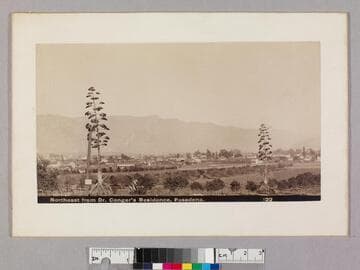
  • Northeast from Dr. Conger's residence, Pasadena

    Northeast from Dr. Conger's residence, Pasadena

    Visual Materials

    Landscape view of agricultural fields, a dirt road, and houses and buildings of Pasadena, California, scattered in the distance, with the San Gabriel Mountains in the background, as seen from the home of Dr. Orville H. Conger. Two agave or "century plants." sit in the foreground.

    photPF 24436

  • Image not available

    Judson-Fairbanks Papers

    Manuscripts

    The collection consists of 36 single-item cataloged letters, 23 of which deal with the Judson Family, while the remaining 13 have to do with the Civil War. In addition, there are 5 letters, 5 bills and receipts, and 1 broadside that deal with the accidental death of Martin L. Fairbanks in 1866 and the recovery of his body. The bulk of the letters are written by Everitt Judson to his wife Philuta, while the remaining letters are written between various members of the Judson family. The letters concerning the accidental death of Martin L. Fairbanks are mostly written by or to his brother-in-law, John Baldwin Judson. The letters are primarily family correspondence in which affairs of the family as well as current events are discussed. The majority of the letters from Everitt to Philuta relate to his business in gold mining and agriculture in California. In those letters are details as to the variety of crops grown, irrigation farming, fruit growers, and land tenure. Everitt's letters also frequently mention economic conditions in California, domestic relations in the 19th century, and Indian attacks, interspersed between descriptions of Placerville and Visalia, Calif. Other topics that are briefly addressed include telegraphs, railroads, the Mormons, churches, and the Central America steamship. The letters pertaining to the Civil War discuss the Quartermaster Corps., religious practices in camp, and military chaplains. Some letters provide descriptions of Memphis, Tenn., and Washington, D.C., while others make brief mention of Abraham Lincoln (1809-1865) and the political climate of the time.

    mssHM 62780-62821

  • Image not available

    Oakland, Calif. Everitt Judson. To Philuta Judson

    Manuscripts

    The collection consists of 36 single-item cataloged letters, 23 of which deal with the Judson Family, while the remaining 13 have to do with the Civil War. In addition, there are 5 letters, 5 bills and receipts, and 1 broadside that deal with the accidental death of Martin L. Fairbanks. The letters are primarily family correspondence in which affairs of the family as well as current events are discussed, including such topics as agriculture and economic conditions in California. Everitt Judson also writes about his ranch on the Kern River as well as about the cities of Placerville and Visalia. The letters pertaining to the Civil War discuss the Quartermaster Corps. in Memphis while J. Watts Judson worked there, religious practices in camp, peoples' political views about the government at the time, military chaplains, and briefly mention Abraham Lincoln.

    HM 62789

  • Image not available

    Placerville, Calif. Everitt Judson. To Philuta Judson

    Manuscripts

    The collection consists of 36 single-item cataloged letters, 23 of which deal with the Judson Family, while the remaining 13 have to do with the Civil War. In addition, there are 5 letters, 5 bills and receipts, and 1 broadside that deal with the accidental death of Martin L. Fairbanks. The letters are primarily family correspondence in which affairs of the family as well as current events are discussed, including such topics as agriculture and economic conditions in California. Everitt Judson also writes about his ranch on the Kern River as well as about the cities of Placerville and Visalia. The letters pertaining to the Civil War discuss the Quartermaster Corps. in Memphis while J. Watts Judson worked there, religious practices in camp, peoples' political views about the government at the time, military chaplains, and briefly mention Abraham Lincoln.

    HM 62784

  • Image not available

    Oakland, Calif. Everitt Judson. To Philuta Judson

    Manuscripts

    The collection consists of 36 single-item cataloged letters, 23 of which deal with the Judson Family, while the remaining 13 have to do with the Civil War. In addition, there are 5 letters, 5 bills and receipts, and 1 broadside that deal with the accidental death of Martin L. Fairbanks. The letters are primarily family correspondence in which affairs of the family as well as current events are discussed, including such topics as agriculture and economic conditions in California. Everitt Judson also writes about his ranch on the Kern River as well as about the cities of Placerville and Visalia. The letters pertaining to the Civil War discuss the Quartermaster Corps. in Memphis while J. Watts Judson worked there, religious practices in camp, peoples' political views about the government at the time, military chaplains, and briefly mention Abraham Lincoln.

    HM 62790