Opening Hours
Daily: 10 A.M.–5 P.M.
Closed on Tuesdays
1151 Oxford Road
San Marino, CA 91108
Rare Books
Image not available
Daily: 10 A.M.–5 P.M.
Closed on Tuesdays
1151 Oxford Road
San Marino, CA 91108

Image not available
Visual Materials
The Singleton Collection is organized into four discrete yet interrelated units. The first consists of 79 photographs by Mathew Brady (1823-1896) and Alexander Gardner (1821-1882) of scenes of the Civil War taken between 1861 and 1865. Included are group portraits of generals with their staffs, important wartime sites and activities, and photographs of paintings depicting various skirmishes. While the photographs were taken by Brady and Gardner during the war, the images were printed around 1885 by John Taylor and marketed by the firm of Taylor & Huntington. These photographer-entrepreneurs hoped to capitalize on twenty-fifth anniversary war reunions and commemorations by reissuing the once-familiar views. On the verso of each image is a partial list of the photographs sold by Taylor & Huntington for 75 cents a piece. The second grouping of photographs depicts two views of Abraham Lincoln and portraits of the Lincoln conspirators and their execution. These were also taken by Brady and Gardner during the war and, as with the first group, printed and issued around 1885 by Taylor & Huntington. Of particular rarity are the fourteen photographs of the Lincoln assassination conspirators including portraits of David Herold, George Atzerodt, Edward Spangler, two views of Lewis Payne, two views of Michael O'Laughlin, and an unidentified conspirator. Additionally, there is a complete set of three images depicting the execution of Mrs. Surratt and the conspirators taken by Alexander Gardner on July 7, 1865, as well as three of the five known images documenting the execution of Captain Wirz, the notorious Keeper of Andersonville Prison. Eighty-three cabinet portraits of Confederate Generals and other Southern leaders by George S. Cook (1819-1902) comprise the third section of the collection. Cook was a friend and former employee of Matthew Brady, and he provided E.& H.T. Anthony Co. with portraits from the South, including the first portrait of Colonel Robert Anderson. These portraits may come from sources other than Cook as he purchased competing photographers negatives, issuing them on his mounts. These portraits were taken in the 1860s but printed between 1880 and 1890 when Cook operated his Richmond, Virginia studio at 913 East Main Street. The last grouping of photographs contains 210 images by William H. Tipton (1850-1929), the self-described "Battlefield Photographer." The imperial-sized photographs depict the numerous monuments erected on the Gettysburg battlefield to honor the soldiers who fought and died in this decisive battle. The photographs date from the 1880s. The Singleton Collection constitutes of one of the most complete historic archives of the Gettysburg monuments.
photCL 445
Visual Materials
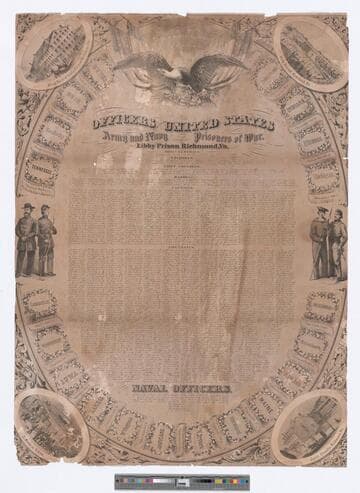
Image of a register of United States Army and Navy prisoners of war listing the names of officers imprisoned by rank during the American Civil War; four captioned scenes from Confederate military prison Libby Prison in Richmond, Virginia, in corners; bald eagle with American flag, shield, arrows and olive branch at top center; Union soldiers and sailors with swords, bayonets, and harpoons at left and right center.
priJLC_MIL_000797
Image not available
Rare Books
66894
Image not available
Rare Books
99689
Image not available
Visual Materials
The Jay T. Last collection of household prints and ephemera contains over 7,800 printed items advertising household products and related businesses in the United States from the 1830s to the 1920s, with the bulk of the items spanning from 1850 to 1900. The collection consists largely of lithographed ephemera produced for American businesses affiliated with the manufacture, distribution, and sale of furnishings, appliances, cleaning products, and related tools and supplies. Cleaning products include soaps, polishes, bleaches and ammonias, starches, and pest control. Furnishings include lighting, furniture, clocks and art objects, tableware, doors and other building components, as well as the manufacturers and retailers of these goods. Tools and appliances include brooms, irons, and kitchenware as well as refrigerators, freezers, sewing machines, stoves and ranges, and washers. The collection supports various fields of research relating to home decorating, housekeeping, laundering, and washing including products used to adorn interiors and exteriors, clean and maintain clothes, polish and preserve household objects, tidy living spaces, and cleanse the human body. The images provide a resource for studying American domesticity and related industries in the 19th and early 20th centuries, along with the evolution of advertising strategies. The items also offer insight to consumer buying habits, brand loyalty, and popular use for a variety of household items and products. As graphic materials, the collection highlights developing techniques and trends in printmaking while documenting the artists, engravers, lithographers, printers, and publishers involved in the creative process.
priJLC_HHD