Opening Hours
Daily: 10 A.M.–5 P.M.
Closed on Tuesdays
1151 Oxford Road
San Marino, CA 91108
Daily: 10 A.M.–5 P.M.
Closed on Tuesdays
1151 Oxford Road
San Marino, CA 91108
Manuscripts
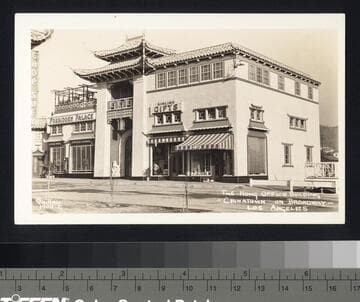
The Hong buildings were commissioned by Y. C. Hong, who was the first Chinese person to pass the California Bar.
mssHong Family papers
![永樂大典 : [卷 10270-10271]](/_next/image?url=https%3A%2F%2Frail.huntington.org%2FIIIF3%2FImage%2F22APN4PAPBY6%2Ffull%2F%5E360%2C%2F0%2Fdefault.jpg&w=750&q=75)
Rare Books
Cover title. On double leaves, oriental style. Ming Jiajing 41 nian zhi Ming Longqing yuan nian [1562-1567] jian zhi mo xie hong hei liang se chong chao ben. Ba hang er shi ba zi. 明嘉靖41年至明隆慶元年[1562-1567]間之摹寫紅黑兩色重抄本. 八行二十八字. Manuscript, in red and black ink, copied between the 41st year of the Jiajing - 1st year of the Longqing reign periods of the Ming dynasty. Eight columns per half-folio; 28 Chinese characters per column.The Yongle Encyclopedia (Yongle dadian 永樂大典), a title that could also be translated as the Great Compendium of the Yongle Reign, was commissioned in 1403 by the Yongle Emperor of the Ming dynasty to compile and preserve important texts from ancient and imperial China into a single set. When completed in 1408, the Encyclopedia consisted of 22,877 sections bound in 11,095 volumes and was considered the largest of its kind in the world. Organization of the content was based on the Hongwu zhenyn 洪武正韻, a rhyming dictionary developed in the fourteenth century. These sections, 10270 and 10271, of the Yongle Encyclopedia deal with the education of an heir apparent. Its contents were taken from the "King Wen as Son and Heir" chapter of the Book of Rites (Liji 禮記), a collection of texts on social forms and rituals compiled by Confucian scholars during the Han dynasty (206 BC-220 AD). In 1557, after a fire that nearly destroyed the set, the Jiajing Emperor ordered copies to be made from the original. From 1562 to 1567, a team of 109 court scribes transcribed the entire Encyclopedia. Today only about 419 unique Jiajing volumes have survived. The fate of the original volumes is still unknown.
645576
Image not available
Rare Books
One of the four texts of Hyakumantō darani printed by order of the Empress Shōtoku in the years of Tenpyō Hōji 8-Jingo Keiun 4 [764-770]; text consists of 31 lines, 5 characters per line (58 x 395 mm.), placed in wooden pagoda (103 x 215 mm). Considered one of the world's oldest extant printed matter.
653894
Image not available
Rare Books
Black and white image of Chinese man from Nanjing in the Quing Dynasty. Accompanied by extensive text which is divided into three sections. Two sections list the menu for a pleasure house in Yokohama, giving names of dishes with clear Dutch linguistic influences, for example "Hasuteisoppu" for a soup dish. The text which accompanies the Chinese man identifies him as a native of Yangzhejiang 揚折江, Nanjing, named Rin Hōchū 林鳳忠 [Lin Fengzhong in Chinese], aged forty-one. Dates from the late Edo period. The Yokohama pleasure district was opened in 1859.
647770
Image not available
Rare Books
Reginald Fleming Johnston was a British colonial officer, scholar and a writer with a passion for China and Chinese culture. From 1919 to 1924 he was tutor and adviser to the last emperor of China. The emperor P'u-i had abdicated his throne in 1912. However, in order to ensure a rapid and peaceful transfer of authority, he was allowed to retain his title and was permitted to remain in residence. Johnston was able to observe and chronicle the last years of the Ch'ing dynasty.
654422
Image not available
Rare Books
"This book (originally published in 1972 by The Seabury Press as The Orchid Boat) is the first representative collection of the poetry of Chinese women to appear in English. Unlike Japan with its long tradition of women writers, poetry by women did not become fashionable in China until the Ch'ing dynasty (1644-1911), although poems from earlier centuries that do in fact survive will quickly dispel any stereotyped views. Included here are samplings from the legendary earliest poetry of courtesans, palace women, and Tao priestesses to works by contemporary Chinese women living in both the East and West."--Back cover.
660941