Opening Hours
Daily: 10 A.M.–5 P.M.
Closed on Tuesdays
1151 Oxford Road
San Marino, CA 91108
Rare Books
Image not available
Daily: 10 A.M.–5 P.M.
Closed on Tuesdays
1151 Oxford Road
San Marino, CA 91108

Image not available
Manuscripts
A micrographic drawing of Marie Anne Victorie, the Dauphine of France on a horse-drawn chariot surrounded by illustrations of allegorical figures. Images include an angel, a lion with a royal crest, cherubs, and a man symbolizing Hercules. The drawing is formed entirely of microscopic text from an accompanying volume containing 221 folios of an Italian poem by Ignatio Francesco Muligin honoring the Dauphine. The drawing's letters are read horizontally with a microscope or magnifying glass. The volume is in contemporary binding of red morocco with gilt spine and edges. Drawing possibly illustrated by Pierre Mignard (1612-1695), and volume bound by Bernard Bernache (active 1684-1721).
mssHM 84368
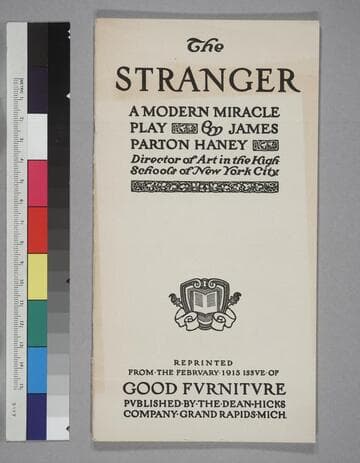
Visual Materials
One pamphlet entitled The Stranger: A Modern Miracle Play, by James Parton Haney, "Director of Art in the High Schools of New York City. Reprinted from the February 1915 Issue of Good Furniture, Published by the Dean Hicks Company, Grand Rapids, Mich[igan]." The pamphlet consists of an introduction and the text of the play; it is 16 numbered pages in length. The front cover is illustrated with an emblem and decorative pieces; the back cover is blank.
ephKAEE
Image not available
Manuscripts
This thesis deals with France's attempts to establish an empire in Mexico throughout the 19th century. The manuscript contains an index, introduction, bibliography and several maps throughout as illustrations. Also included are photostat copies of four pages from the publication The plains Indians and New Mexico, 1751-1778 by Alfred B. Thomas (copies from the Bancroft Library).
mssHM 78344
Image not available
Manuscripts
The documents demonstrate the range of legal, financial, and real estate-related transactions initiated by or concerning the Oreña Family and their associates. Included in this series are title deeds, land claims, and land grants pertaining to the family's properties in Santa Barbara, San Luis Obispo, Ventura and Los Angeles Counties. Also included are receipts and invoices. The manuscripts include four works pertaining to the Oreña Family as well as other early California families, namely the de la Guerra family. The series also contains two typewritten manuscripts: the first is Occurrences in California, as reported by Angustias de la Guerra Ord and the second is Carlota Koch's "La Guipuzcoana," which chronicles the lives of Gaspar Orena, Cesareo Lataillade, Maria Antonia de la Guerra, and those of their acquaintances. The correspondence includes personal and business letters to and by the Oreña Family members and their associates. Among the authors is Alfred Robinson (b. 1806-d.1895), author of Life in California (1891). Four photographs of the Columbus Library in Seville, Spain comprise the fourth series. These black-and-white photos were taken in September 1955. The photographer, who included only his/her initials of "AK," indicated that the images are not available for publication. Finally, three items comprise ephemera. These include two 1891 arguments issued by the Supreme Court of the State of California relating to the case of C.E. Lataillade, Plaintiff and Appellant, vs. Gaspar Oreña, Defendant and Respondent. The final item in this series is an autographed note written on a fragment of an ANP-ANETA News Bulletin, dated April 23, 1951.
HM 70964
Image not available
Rare Books
American propaganda leaflet directed to the Japanese people during the closing stages of World War II. Printed on 2 sides on orange paper and illustrated with photographic reproductions. The leaflett was produced sometime beween the surrender of Germany in May 1945 and the surrender of Japan on August 15, 1945. The text makes the argument that Japanese citizens will be provided with food, clothing and shelter under American forces and not to believe Japanese government messages to the contrary. This point is illustrated by showing defeated Germans welcoming and being cared for by American troops on one side. The other side of the leaflet explains that Japanese people on Saipan were provided with food and medical care after the arrival of U.S. troops and two illustrations depict Japanese families receiving food and Japanese men in an internment camp eating lunch. The leaflet also states that anyone mistreating surrendered enemies will be severely punished. Tens of thousands of propaganda leaflets like this one were dropped from the air over Japanese cities in an attempt to persuade citizens to surrender.
653726
![Piers Plowman : [manuscript]](/_next/image?url=https%3A%2F%2Frail.huntington.org%2FIIIF3%2FImage%2F22APN4RCY0_F%2Ffull%2F%5E360%2C%2F0%2Fdefault.jpg&w=750&q=75)
Manuscripts
ff. 1-106v; ff. 107-108v blank. [William Langland] Piers Plowman. Incipit: In a somer sesoun whan softe was þe sonne/ y shope me into shroudes as y a shep were. Explicit: And seende me hap and hele til y haue Peres plouhman/ And sethe he gradde aftur grace tyl y gan awake. English. IMEV 1459; C text, i group; ff. 60 and 61 reversed in binding. R. W. Chambers, "The Manuscripts of Piers Plowman in the Huntington Library and their Value for Fixing the Text of the Poem," HLB 8 (1935) 1-25; Piers Plowman: The Huntington Library MX (HM 143) reproduced in Photostat with Introduction by R. W. Chambers and Technical Examination by R. B. Haselden and H. C. Schulz (Huntington Library 1936); D. Pearsall, ed., Piers Plowman by William Langland: An Edition of the C-text (London 1978) from this manuscript with variant readings from others. ff. ii-iii verso. [Geoffrey Chaucer] Troilus and Criseyde. Incipit: //So whan thys Calkas knewe by kalkulynge/ And eke by onswere of this Appollo. Explicit: Of other sekenesse lest men of hym wende/ That the hoote fir of loue hym brende//. English. Two non-continuous leaves representing leaves 2 and 7 of a gathering of 8 leaves of a lost manuscript, and containing 20 stanzas: f. ii recto-verso: //So whan thys Calkas knewe by kalkulynge/ And eke by onswere of this Appollo . . . And under efte gan hem whielen bothe/ After hire cours ay whil that they were wrothe//; f. iii recto-verso: // And to the god of loue thus sayde he/ With pitous vois o lord now youres is . . . Of other sekenesse lest men of hym wende/ That the hoote fir of loue hym brende//. IMEV 3327; R. K. Root, ed., The Book of Troilus and Criseyde by Geoffrey Chaucer (Princeton 1926) 1:71-140 and 1:421-490; M. B. Parkes and R. Beadle, Geoffrey Chaucer, Poetical Works: a facsimile of Cambridge University Library MS Gg.4.27 (Cambridge 1980-81) 3:65 note 94 referring to this manuscript. Assigned Date: s. XVin.
mssHM 143