Opening Hours
Daily: 10 A.M.–5 P.M.
Closed on Tuesdays
1151 Oxford Road
San Marino, CA 91108
Daily: 10 A.M.–5 P.M.
Closed on Tuesdays
1151 Oxford Road
San Marino, CA 91108

Image not available
Manuscripts
This manuscript is Snyder's account of his experiences in the mercantile business in Monterey County, California beginning in 1872. He ran a "branch store" and a "hotell." At length and in detail, Snyder describes an incident where his store was robbed by armed "Spanyards," the leader of whom he names as "Vasques." The bandits shot and killed a partially deaf man when he did not heed their demands for him to submit, and shot a second man hiding in a nearby barn. After killing a third man, Vasques declares that "he had only one way to make a living and that was by robbing, and as long as other people had any money he intended to have his Share of it if he had to kill a man to gett it." The bandits did not kill Snyder because he "submitted." The bandits stole eleven horses, including one that had been a present to Mrs. Snyder, loaded them with the stolen goods, and rode away. Snyder called the aftermath "a Mournfull looking Site." He reports that Vasques was eventually captured in San Jose and hanged. With typewritten card containing a brief biography of Snyder.
mssHM 16695

Visual Materials
By the mid-fifties, helicopters were being used by the Edison Company to carry snow surveyors into the back country.
photCL SCE 12 - 00191
Image not available
Visual Materials
The most difficult of surveying assignments at Big Creek was to run levels and alignments for tunnels across the rugged terrain of the back country. Here, T.R. Bond and his party pose at an unidentified location, about 1912. [THIS IS NOT AN EDISON PHOTO! DO NOT USE THIS NEGATIVE FOR ANY PURPOSE WITHOUT WRITTEN PERMISSION FROM WILLIAM A. MYERS.]
photCL SCE 12 - 00052
Visual Materials
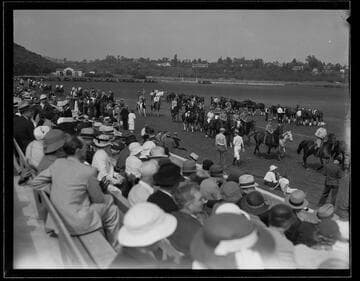
Image of spectators in the grandstands and polo players on horseback at the Riviera Country Club polo field in Santa Monica Canyon in Pacific Palisades, California, with a line of automobiles parked at the far end of the field.
photCL_555_06_791
Visual Materials
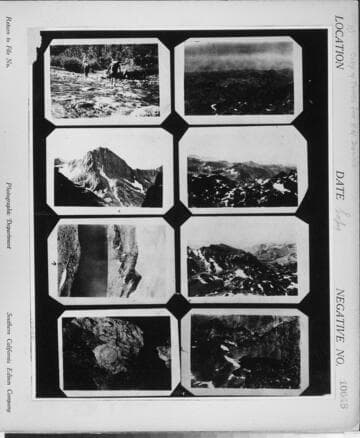
Unidentified images - Copy of 8 small prints for H. W. Dennis [mountain back-country shots]
photCL SCE 02 - 10648
Image not available
Rare Books
The west gave us our best-loved national hero, the cowboy. Cowboy country is about this proud man on horseback and his equally colorful employer, the rancher, who have both played such a large part in putting food on America's table. The text carries the reader back 200 years to a string of ranchos along the California coastline, stocked with semi-wild longhorns and operated by the Spanish settlers. It also tells of the cattle drives to California after the gold rush of 1849 involving 300,000 head. Some of these trail routes were as long as 2,000 miles and took over six months to complete. The story continues into the San Joaquin Valley and gives the history of early ranches, including the Miller and Lux Ranch, Kern County Land Company, and the Tejon Ranch, which has continued to be one of California's leading ranches since 1859. Much of Cowboy country takes place on the author's homerange, the Kern River Valley, over the past 110 years.
609986