Rare Books
Robert Jarvik and the first artificial heart
Image not available
Daily: 10 A.M.–5 P.M.
Closed on Tuesdays
1151 Oxford Road
San Marino, CA 91108

Image not available
Rare Books
Artificial hearts are seductive devices. Their promissory nature as a cure for heart failure aligned neatly with the twentieth-century American medical community's view of the body as an entity of replacement parts. In Artificial Hearts, Shelley McKellar traces the controversial history of this imperfect technology beginning in the 1950s and leading up to the present day. McKellar profiles generations of researchers and devices as she traces the heart's development and clinical use. She situates the events of Dr. Michael DeBakey and Dr. Denton Cooley's professional fall-out after the first artificial heart implant case in 1969, as well as the 1982-83 Jarvik-7 heart implant case of Barney Clark, within a larger historical trajectory. She explores how some individuals-like former US Vice President Dick Cheney-affected the public profile of this technology by choosing to be implanted with artificial hearts. Finally, she explains the varied physical experiences, both negative and positive, of numerous artificial heart recipients. McKellar argues that desirability-rather than the feasibility or practicality of artificial hearts-drove the invention of the device. Technical challenges and unsettling clinical experiences produced an ambivalence toward its continued development by many researchers, clinicians, politicians, bioethicists, and the public. But the potential and promise of the artificial heart offset this ambivalence, influencing how success was characterized and by whom.
659168
Image not available
Rare Books
Dr. Don Chapman, who introduced heart catheretization to this part of the country, was present at the first heart transplant performed in the United States as well the first artificial heart surgery here. He explains the medical treatment of coronary artery disease in both men and women, including the risk factors, and discusses new diagnostic techniques. Also included are the use of artificial pacemakers; angioplasty and coronary bypass surgery; the exciting field of heart and lung transplant, and a brief look at Cellular Biology, the "wave of the future." Besides tracing the growth of cardiology and the Texas Medical Center, this book reflects, in an entertaining and educational way, the constantly changing patterns in the practice of medicine in the United States.
659065
Image not available
Rare Books
J. Navratil The performance of operations on the heart and its replacement by a transƯ planted or artificial heart has been an age old dream of man. Rehn for example in an early attempt, in 1868 performed a closure of a heart wound after a thoracic puncture. At that time noone thought that this attempt was the beginning of cardiac surgery. The dream was partially realized when the replacement of the heart function by the heart-lungmachine became possible. Immediately following the first operations, cardiac surgeons and cardiologists saw with great enthusiasm that this machine could be an important tool for correcting congenital and nonƯ congenital heart diseases. However, the heart-lungmachine was soon seen to not be an optimal instrument for controlling cardiac failure after cardiopulmonary bypass or myocardial infarction. then arose for the development of mechanical assistance to the heart. Concepts The rollerpump was first designed for assisted circulation and could be applied clinically in 1962. A new concept of mechanical assistance to the heart was proƯ vided by the intra aortic balloon pump and later by the bypass ventricles. Use of the intra aortic balloon pump can reduce cardiac work by counterpulsation in accord with the natural ECG. The bypass ventricle can functionally replace the heart in series or parallel to the natural heart. The intra aortic balloon pump, now an established method, has reduced the number of patients who used to die from cardiac failure.
658821
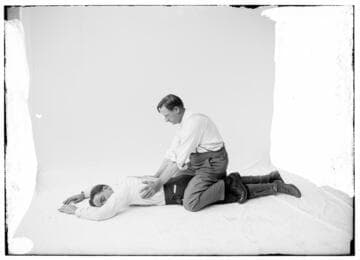
Visual Materials
A1.7 - "Safety First" - Artificial respiration, first position on face [First-aid demonstration.]
photCL SCE 02 - 02942
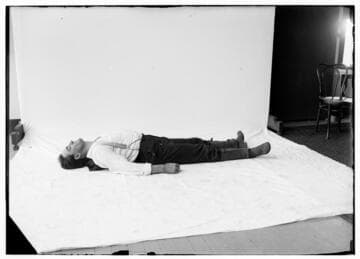
Visual Materials
A1.7 - "Safety First" - Artificial respiration, first position on back [First-aid demonstration.]
photCL SCE 02 - 02944
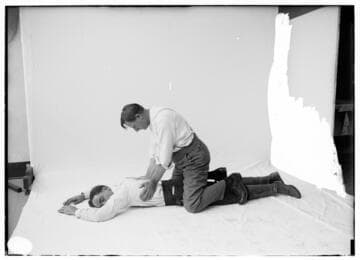
Visual Materials
A1.7 - "Safety First" - Artificial respiration, second position on face [First-aid demonstration.]
photCL SCE 02 - 02943