Rare Books
Benaroya Hall : home of the Seattle Symphony : design for music
Image not available
You might also be interested in
Image not available
Music, acoustics & architecture
Rare Books
Acoustics is one of the youngest classical sciences, with the theoretical foundations being formulated by Lord Rayleigh in 1877. In the period between 1898 and 1905, Wallace Clement Sabine advanced the application of acoustics to architecture. But it was the development of the vacuum-tube amplifier, loudspeakers, and noise-free microphones in the second quarter of the 20th century that allowed the amassing of enough accurate data to make acoustics an effective engineering science. Before electronic equipment was invented, acousticians lacked both the means to produce specific types of sounds and to then measure the strength of them. Before these tools existed, designers of music halls could learn about acoustics only by observing other halls, speculating about which factors were responsible for glorious sonorities in one place and muddled cacophony in another. The information herein applies to any concert hall or opera house, the result of hundreds of interviews with opera and symphony orchestra conductors, performers, and music critics; of listening to music in some sixty different halls; of collecting precise acoustical measurements, accurate architectural drawings, and photographs of said halls. The story of the acoustics of many of the world's greatest halls is told as simply as possible, while maintaining technical accuracy.
721098
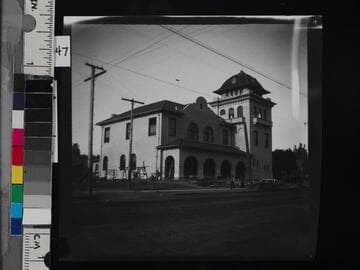
Santa Monica City Hall
Visual Materials
View of the Santa Monica city hall building at Fourth Street and Santa Monica Boulevard, still in the process of being built. There are scaffolds, construction workers, and lumber piled nearby.
photCL_555_06_147
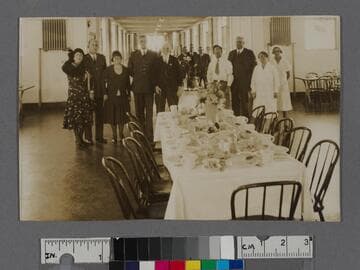
Mess Hall in Soldier's Home in West Los Angeles
Visual Materials
Group portrait of men and women at the Soldiers' Home (formally called the Pacific Branch of the National Home for Disabled Volunteer Soldiers) in Sawtelle, West Los Angeles (location called Santa Monica when first established). View of the dining hall, showing dining table.
photCL_555_01_1913
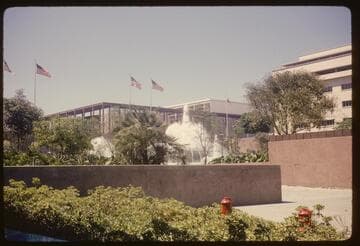
Civic Center Mall next to Hall of Administration
Visual Materials
Arthur J. Will Memorial Fountain at the Mall. Music Center's Mark Taper Forum and Ahmanson Theatre still under construction on Grand Avenue. Building at right is the Los Angeles County Hall of Administration.
photCL 486
Image not available
Series I. Hall of Administration files
Manuscripts
Series I consists of papers from Molina's main office at the Kenneth Hahn Hall of Administration. These documents highlight a wide range of issues covered in Molina's work as a County Supervisor. The files contain agenda, correspondence, memoranda, reports, press releases, photographs, site plans, audiovisual and electronic resources, and notes about many topics Molina and her team focused on throughout her terms, such as county services, social and political events, cities and unincorporated areas, LAC+USC medical center, budget, and legislation. A small portion of this series also contain files that were created when she was a member of the State Assembly (1982-1987) and the City Council (1987-1991), such as those on the construction of a state prison in East Los Angeles.
mssMolina
Image not available
Theodore Hall photographs of Bunker Hill, Los Angeles and environs
Visual Materials
This collection contains approximately 9,000 negatives (2 ¼ x 2 ¼ inches), 7 binders of contact prints of a large portion of the negatives, and 3 photobooks (11 x 14 inches). The photographs were taken by Theodore Hall, an avid amateur photographer and resident of Bunker Hill, Los Angeles from 1938 to 1963. Photographs depict the historic structures and streets of the neighborhood before and during the urban renewal of the 1950s, when buildings were razed and much of the hill was lopped off and graded. Hall photographed houses, storefronts, signs, architectural details, cars, and often the residents: shopkeepers, newsstand vendors, local children, and people on their front porches. A diverse population including African American, Asian American, Latin American, and white residents are pictured in everyday activities in the neighborhood. Grand Central Market, the downtown food and grocery emporium, is featured extensively in detailed images of vendors, customers, neon signs, and food stalls. Also seen on Bunker Hill are hotels and apartment buildings, the Angels Flight funicular railway, Victorian mansions turned into rooming houses, liquor stores, and construction crews grading land and pouring cement. Many historic buildings are seen in disrepair, and some are pictured in the midst of being torn down. Other Los Angeles sites depicted are: Union Station, City Hall, Olvera Street and the Plaza, churches, freeways, and automotive tunnels. The contact print binders also contain Hall's photographs of friends, social gatherings, camera club members, practice portrait sessions, annual visits to family in the San Francisco Bay Area, and a few day trips in Southern California. Some of the Los Angeles architects whose buildings are represented are: John C. W. Austin, Austin and Brown, Welton Becket, Dodd and Richards, Frederick R. Dorn, Edelman & Barnett, Theodore A. Eisen, Charles O. Ellis, Arthur L. Haley, Marsh and Russell, T. J. McCarthy, William H. Mohr, Joseph C. Newsom, John Parkinson, John Cotter Pelton Jr., James M. Shields, Lewis A. Smith, Train and Williams, George Herbert Wyman, and Robert Brown Young.
photCL 384