Rare Books
Quest for empire : the saga of Russian America
Image not available
You might also be interested in
Image not available
Boogie woogie
Rare Books
Casting a wry and satirical eye over New York's modern art world, this novel paints a subversive picture of the loves and lives of artists, dealers and wannabees in New York's cut-throat art scene.
637152
Image not available
The Whole Russian Empire. The European Part of the Russian Empire with the Several Countries that are the Theatre of the Present War between the Turks and the Russians, from Danville's Maps The Asiatic Part of the Russian Empire, with the adjacent Coast of North America from D'Anville's Map
Visual Materials
"The Whole Russian Empire." appears at center top of map; comprised of two maps (European and Asiatic parts) printed separately and physically joined together; Probably intended to be issued as a single map.Kashnor notes: "Indicates the tracks of Russian ships through the Behring Strait and the Sea of Ochozk, land held by the Russian Company, trading centers, &c." This map is an earlier version of 105:028. A fanciful depiction of the Alaskan peninsula with notation: Some pretend that this land may be seen from Bering's Island. Also shows supposed Company Land and Gama Land. Prime meridian: Ferro. Relief: pictorial. Graphic Scale: Miles, wersts. Projection: Pseudocylindrical. Printing Process: Copper engraving. Verso Text: MS note: 29.
105:029 M
Image not available
South America
Visual Materials
Shows the line of Demarkation between the Spaniards & Portuguese as fixed by the Pope Alexander IV in the year 1500 at 42 deg. Prime meridian: London. Relief: pictorial. Graphic Scale: Miles. Projection: Pseudocylindrical. Printing Process: Copper engraving. Verso Text: MS note: 625.
093:625 S
Image not available
A single man
Rare Books
George, the protagonist, is adjusting to life on his own after the sudden death of his partner, and determines to persist in the routines of his daily life; the course of A Single Man spans twenty-four hours in an ordinary day. An Englishman and a professor living in suburban Southern California, he is an outsider in every way, and his internal reflections and interactions with others reveal a man who loves being alive despite everyday injustices and loneliness. Wry, suddenly manic, constantly funny, surprisingly sad, this novel catches the texture of life itself.
646043

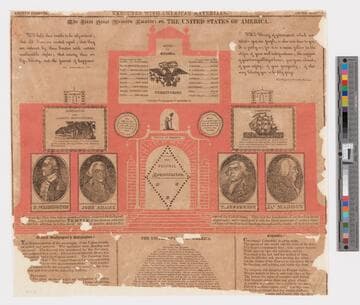
The first great western empire: or, the United States of America
Visual Materials
Image of a patriotic broadside illustrated with emblems of the United States interspersed with text; central framework incorporates a small "Temple of Freedom" with a small Liberty figure, and containing the words "The Federal Constitution;" oval bust-length portraits of Presidents George Washington, John Adams, Thomas Jefferson, and James Madison; vignettes above represent Agriculture and Domestic Manufactures, the "immoveable pillars of the Independence of our country," and Commerce, "a strong support to our national edifice;" seal of the United States and a listing of the names of the seventeen states with their 1810 census figures at top center; quotations and brief texts including "General George Washington's resignation," a description of the geography, government, and people of the United States, and the song "Columbia" written by Dr. Timothy Dwight IV, President of Yale College.
priJLC_POL_002639
Image not available
The excursion
Rare Books
Written for the very audience it portrays, this novel introduces the heroine, Maria Villiers, to London's "gentle" society and its glittering pastimes. Brooke drew upon the English courtship novel in the tradition of Eliza Haywood, Henry Fielding, and Frances Burney for her novel's overarching plot structure. But instead of concentrating on Maria's romantic adventures, she experiments with unusual treatments of subplots and unconventional characters. The most interesting aspect of her story is the development of Maria's ambition to win fame and fortune as a writer; it is one of the few portraits of a woman with literary ambitions by an early woman writer. Brooke's wry narrative voice foreshadows that of Jane Austen. The second volume in the series Eighteenth-Century Novels by Women, The Excursion contributes to our understanding of the development of the novel and offers a lively view of women's position in eighteenth-century English society. The editors' introduction places The Excursion firmly in the tradition of the English novel, provides a fresh biography of Brooke, and brings together the most important eighteenth- and twentieth-century criticism of Brooke's work.
606179