Skip to content

OPEN TODAY: 10 A.M.–5 P.M.

Tickets

Rare Books

The Central Park : explained and illustrated in familiar form

Image not available


You might also be interested in

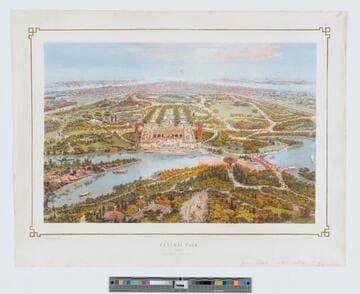
  • Central Park. (Summer.)

    Central Park. (Summer.)

    Visual Materials

    Image of an aerial landscape view of Central Park in New York City showing the Bethesda Terrace, Arch Bridge Fountain, the Ramble and lake, boats on the water, and the island of Manhattan stretching into the distance.

    priJLC_VIEW_000537

  • Image not available

    Central Park

    Visual Materials

    The Peabody Collection consists of 672 glass plate negatives in various sizes, 1054 film negatives in various sizes, 24 photograph albums, 887 loose photographs in a variety of formats, published works, and manuscript material, created and collected by Henry G. Peabody, 1859-1993 (bulk 1890s-1900s). The materials collectively describe Peabody's long career as a commercial landscape photographer working on both the east and west coasts of the United States. The photographs and negatives depict Peabody and his family; landscape views in New England, Canada, the western United States, California, and Mexico; Native Americans; city and landscape views in Great Britain, France, and Switzerland; portraits; architectural renderings; plants and animals; unidentified landscapes; and miscellaneous images. Additional photographers and photographic firms represented in the collection include Alexander Hesler, Charles F. Lummis, and Spence Air Photos. The published works contain photographs by Peabody. The manuscript material provides information about Peabody's negatives; contains catalogs of Peabody's works for sale; describes Peabody's commercial dealings as both a photographer and seller of photographic equipment; and contains ephemeral material collected by Peabody throughout his life.

    photCL 478

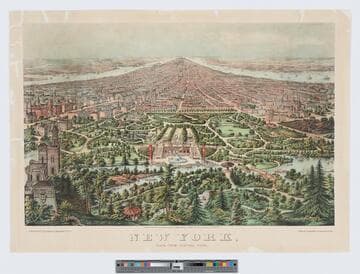
  • New York, taken from Central Park

    New York, taken from Central Park

    Visual Materials

    Image of an aerial landscape view of Central Park in New York City showing the Bethesda Terrace, Arch Bridge, Fountain, the Ramble and lake, boats on the water, and the island of Manhattan stretching into the distance.

    priJLC_VIEW_000561

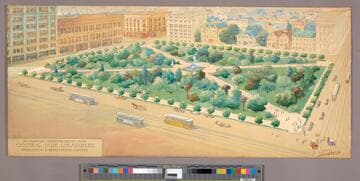
  • Watercolor rendering of Central Park (Pershing Square), Los Angeles, approximately 1910

    Watercolor rendering of Central Park (Pershing Square), Los Angeles, approximately 1910

    Visual Materials

    Watercolor rendering by artist J. F. Dupre for the revitalization of and improvements to Central Park (Pershing Square) in downtown Los Angeles. The design is from the architecture firm of Parkinson and Bergstrom, who devised a new landscape plan for the park area bordered by Olive, Hill, 5th and 6th Streets, around 1910. Central Park was created in downtown Los Angeles in 1866, and experienced multiple changes to its design. The rendering depicts the plan to change the park by arranging it in an axial formation with wider paths to accommodate increasing traffic, a large fountain as the focal point of the intersections, balustrades at the entrances, and concrete coping surrounding the park. The plan was implemented and the park remained in this arrangement for decades. During World War I, the park was the scene of soldier receptions and speeches, and in 1918 the park was renamed "Pershing Square" after General John J. Pershing.

    arch0001

  • Image not available

    Central Park, New York

    Visual Materials

    This is a collection primarily of negatives and photographic prints depicting the growth of Santa Monica and Los Angeles, California, from 1860s to 1980s. Many views are cityscapes or street views, showing buildings, storefronts, homes and roads, and documenting the use of railroads, trolleys, streetcars, and automobiles. There are many card photographs by early professional photographers, and also a number of snapshots made by amateurs, some in personal photo albums. The collection's scope also includes early views of many other communities in Southern California (and a few in other states); the beginnings of aviation in Santa Monica, including the first Douglas Aircraft Company buildings; a photo album of residents in Topanga Canyon, ca. 1913; automobile racing in Los Angeles and Santa Monica, 1920s; maritime views; a photo album of U.S. troops in France during World War I; a 1949 real estate development in Apple Valley, California, and others. Besides photographs, a portion of the collection consists of scarce publications and historical ephemera, primarily related to Santa Monica and Los Angeles, including brochures, advertising cards, menus, event programs and other materials. Highlights of the Santa Monica images are aerial views of the buildings along the coast and pier (1920s); several views of the Arcadia Hotel (1880s); the Long Wharf and adjoining railroad and train depot; the first bath houses on the beach; the beach club culture of the 1920s and 1930s; the amusement piers of Santa Monica, Ocean Park and Venice; and the beginnings of the Douglas Aircraft Company. There is a large set of promotional photographs made late 1920s-1930s by Powell Press Service depicting people enjoying Santa Monica's beaches, clubs and outdoor recreation. An important subset within the collection is 407 negatives made ca. 1890 - 1908 by Los Angeles historian and amateur photographer George W. Hazard (1842-1914). Hazard travelled around Los Angeles and vicinity photographing the adobes, houses, streets and storefronts that told the early history of the city. Many of Hazard's negatives have handwritten identifications, naming streets, former homeowners, ranchos, and other historical details. There are a large number of cabinet cards and other card-mounted prints and stereographs. There are 1,264 stereograph prints, highlighted by the works of photographic pioneers William M. Godfrey, Francis Parker, Hayward & Muzzall, and Carleton Watkins. Other formats represented are: glass and film negatives; panoramic prints; 7 photograph albums, photographic postcards, 20th-century color prints and transparencies; and a small number of tintypes, cyanotypes and a set of chromolithographs.

    photCL 555

  • Image not available

    Central Park. Los Angeles Cal. [Photographed December 18, [1896]]

    Visual Materials

    This collection contains photographs by commercial photographers dated ca. 1890-1910 that show images of recreational scenes on Catalina Island, a hotel and public parks in Southern California, and various historical sites in Mexico City. Photographs of Catalina Island include views of Avalon, Sugarloaf Point, sailboats and glass-bottom boats, steamships, bathers at the beach, a tent city, and sailors of the steamship the "San Diego". California views include Missions San Gabriel, San Fernando, and San Juan Capistrano; the Coronado Hotel in San Diego; Central Park, St. James Park, and Hollenbeck Park (all based in Los Angeles); Adams Street in Los Angeles; the Shakespearean actress Helena Modjeska's home in Orange County; and an interior view of Columbia Savings Bank's then president Aaron M. Ozum's residence at 3131 Figueroa Street, Los Angeles. Photographs of Mexico depict the Cathedral de Mexico, Paseo de la Reforma, interiors and exteriors of Castillo de Chapultepec, Hotel Iturbide, Mercado Volador, Canal de la Viga, the daily lives of Mexican citizens, the Zócalo (now known as the Plaza de la Constitución), and various street scenes. Miscellaneous photographs are of cargo ships at shipping docks possibly in San Francisco, a steamship, and gardens. C.B. Waite photographed 19 of the 114 prints in this collection. Other photographers who contributed to this collection are Charles F. Ironmonger, Frank L. Park, Percy Cox and R.J. Carmichael, J.C. Hatton, Noren F. Swenson, and the Special View Company. Two photographers were identified on some photographs only by their surname: Graham and Scott.

    photCL 110