Opening Hours
Daily: 10 A.M.–5 P.M.
Closed on Tuesdays
1151 Oxford Road
San Marino, CA 91108
Rare Books
Image not available
Daily: 10 A.M.–5 P.M.
Closed on Tuesdays
1151 Oxford Road
San Marino, CA 91108

Image not available
Manuscripts
The American Indian File is an artificially assembled collection which includes miscellaneous pieces and five smaller groups of papers concerning Indians in the 17th, 18th and 19th centuries. The documents are primarily concerned with the transfer of land from Indians to whites and include deeds, indentures, treaties, proclamations and mortgages. Nearly all the papers are dated from 1634 to 1815, with a very few pieces from the late 19th and the 20th centuries. Also included is information on military and political affairs, negotiations and Indian ethnology, primarily between 1780 to 1850. Tribes belonging to the Iroquoian language family, including the Cherokees and Senecas, are most fully represented, but tribes in the Algonquian family, especially in the Great Lakes region are also represented (Ottawa and Saginaw Chippewa).
mssIndian File
Image not available
Visual Materials
A collection of glass plate negatives and prints collected by Major George W. Ingalls, a United States Indian agent, 1872-1875, who worked among Paiute and other tribes in the West, as well as among Great Plains, Great Basin and Eastern tribes relegated to Indian Territory. Many of the photographs were made in the early 1870s and include photographs by John K. Hillers made during expeditions with John Wesley Powell in 1873 and 1874; views of Indian children attending seminary schools; portraits of tribal leaders in western suits; missionaries and churches in Indian Territory. There are also portraits of Indian delegates in Washington D.C.; portraits taken at Council meetings; and early views of Reno, Nevada, from the early 1900s. The majority of tribes represented are from Great Basin and Great Plains regions, but there are also Southwest Indian photographs by A. C. Vroman; and views of Northeast and Southeast Indian tribe members living in Indian Territory or attending annual council meetings. Notably, there is a view of a skull showing an example of head flattening (Folder 33, Item1). Many of the original prints have ink captions in Ingalls' hand. Ingalls' captions often mention if the Indians pictured are Christians or otherwise "reformed." This collection is a mixture of original and copy prints and negatives, as well as a few pieces of ephemera and some manuscript photograph lists and possible lecture notes by Ingalls.
photCL 275
Visual Materials
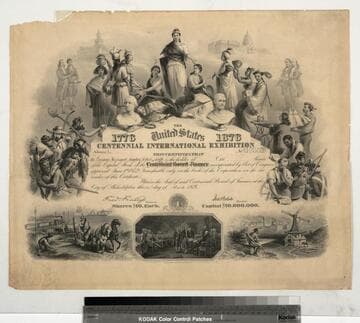
Image of a United States Centennial Exhibition stock certificate with the goddess Columbia at top center surrounded by muses and women in ethnic costumes bearing gifts; an American eagle is flanked by bust sculptures of Presidents George Washington and Ulysses S. Grant at center; working men and Native American Indians portrayed at left to represent 1776; soldiers, and African American man reading, a man with a sewing machine, and a sailor holding a model sailboat at left to represent 1876; three historical vignettes along the bottom portraying a farming scene with machinery, a train, and a steamboat, the signing of the United States Declaration of Independence, and a scene with a windmill and an American Indian man sitting on a log with smoking factories in the background; seal of the Centennial Board of Finance at lower center; certificate is signed by Centennial Board of Finance president John Welsh and treasurer Frederick Fraley.
priJLC_FAIR_001721
Visual Materials
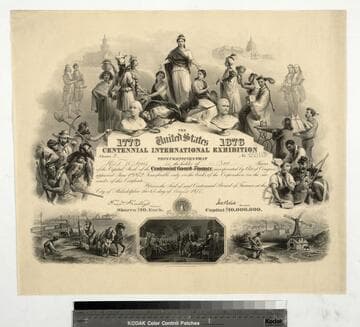
Image of a United States Centennial Exhibition stock certificate with the goddess Columbia at top center surrounded by muses and women in ethnic costumes bearing gifts; an American eagle is flanked by bust sculptures of Presidents George Washington and Ulysses S. Grant at center; working men and Native American Indians portrayed at left to represent 1776; soldiers, and African American man reading, a man with a sewing machine, and a sailor holding a model sailboat at left to represent 1876; three historical vignettes along the bottom portraying a farming scene with machinery, a train, and a steamboat, the signing of the United States Declaration of Independence, and a scene with a windmill and an American Indian man sitting on a log with smoking factories in the background; seal of the Centennial Board of Finance at lower center; certificate is signed by Centennial Board of Finance president John Welsh and treasurer Frederick Fraley.
priJLC_FAIR_001722
Image not available
Visual Materials
A collection of photographs and postcards focusing on Navajo and Hopi Indians and various Indian schools and schoolchildren throughout Arizona, mostly in ca. 1927. There are views of Peach Springs Trading Post, the Cameron Suspension Bridge trading post, missions at Chinle and Lukachukai (Arizona), Navajo family groups, Navajo schools at Tuba City and Oraibi (Arizona), and Navajo school crafts fairs and exhibits. Acoma, Apache, Tohono O'Odham (Papago), and Hualapai Indians are also represented. The photographs were taken from 1890 to 1927, but the bulk of the collection was created during the 1920s. Includes some photographs by George Wharton James, E.E. Hall, and Burton Frasher (Frasher Fotos). These images of Indians were taken as both posed and candid field photographs, in particular of young Navajo schoolchildren during class time and outside of school. Other subjects pictured are L.H. McSparron, owner of Thunderbird Ranch and acting custodian of Canyon de Chelly; Father Leopold Ostermann, the founder of the mission at Chinle; possibly John Lorenzo Hubbell Jr., of the Hubbell trading family; an Indian all-boys track-and-field team at an unidentified school; Indian schoolchildren; and nature views throughout Arizona. The photographs have been arranged by Indian tribe, starting with the tribe with the most photographs and/or postcards. Navajo Indians appear first in the arrangement, followed by Hopi, Apache, and other Southwestern tribes with fewer photographs. Within each tribe, photographs and postcards have been further organized by individual tribe members, activities, crafts, associated communities, and schools. Images of Caucasian people involved in Indian trade, trading posts, and unidentified Indian schools and students are placed at the end of this collection. Russell also collected postcards with images of Southwest Indians, with some cards having correspondence from Russell, addressed to Beatrice Madelleine, Mrs. George R. Simmons, and Madeleine Touchaux (Russell's wife), describing how travel conditions were as well as opinions on the Indians that were encountered.
photCL 399
Image not available
Visual Materials
A collection of glass plate negatives and prints collected by Major George W. Ingalls, a United States Indian agent, 1872-1875, who worked among Paiute and other tribes in the West, as well as among Great Plains, Great Basin and Eastern tribes relegated to Indian Territory. Many of the photographs were made in the early 1870s and include photographs by John K. Hillers made during expeditions with John Wesley Powell in 1873 and 1874; views of Indian children attending seminary schools; portraits of tribal leaders in western suits; missionaries and churches in Indian Territory. There are also portraits of Indian delegates in Washington D.C.; portraits taken at Council meetings; and early views of Reno, Nevada, from the early 1900s. The majority of tribes represented are from Great Basin and Great Plains regions, but there are also Southwest Indian photographs by A. C. Vroman; and views of Northeast and Southeast Indian tribe members living in Indian Territory or attending annual council meetings. Notably, there is a view of a skull showing an example of head flattening (Folder 33, Item1). Many of the original prints have ink captions in Ingalls' hand. Ingalls' captions often mention if the Indians pictured are Christians or otherwise "reformed." This collection is a mixture of original and copy prints and negatives, as well as a few pieces of ephemera and some manuscript photograph lists and possible lecture notes by Ingalls.
photCL 275