Opening Hours
Daily: 10 A.M.–5 P.M.
Closed on Tuesdays
1151 Oxford Road
San Marino, CA 91108
Rare Books
Image not available
Daily: 10 A.M.–5 P.M.
Closed on Tuesdays
1151 Oxford Road
San Marino, CA 91108

Image not available
Rare Books
Item includes words for 636 hymns, without music, and litanies.
646125
Image not available
Manuscripts
Short part songs in English for three and four voices, some songs without words; also, two leaves from a similar music book. Front and back covers are heavily damaged and fragile, handle carefully.
mssHM 13717
Image not available
Manuscripts
This collection contains 40 items (17 manuscripts, 4 letters, and 19 pieces of ephemera) by or related to Ellen Steele Sturges (1837-1930) of Michigan, Montana, and San Bernardino, California, and her family. Items chiefly consist of manuscripts of short stories written by Sturges, as well as two hymns. There is also a short 1-page autobiography by her father, Ebenezer Steele, and a small collection of genealogical and biographical notes detailing Ellen Steele Sturges's family and David Brainerd Sturges's life. One letter in the collection is a rejection notice from S.S. McClure Limited and includes an edited copy of "The Little Somnambulist." An 1852 letter contains a report by Ebenezer Steele regarding his missionary work in 1852 with an Ojibwa tribe in Michigan at "Na-yuh-mah-kauny" (or Naomikong). There is also a short note from Ellen's stepmother, Phebe Steele, recounting Ebenezer Steele's recollections of "Training Day" in Massachusetts. The ephemera includes Ellen Steele Sturges's nursing certificate, a Montana homestead certificate from 1877 to David Sturges, and a Confederate States bond issued by the Central Business College of Sedalia, Missouri, from 1864. There is also an obituary for Ellen Steele Sturges, a photograph of David Brainerd Sturges, two photographic postcards of their house in San Bernardino, California, and a view of buildings in Virginia City, Montana, by photographer O.C. Bundy, circa 1875.
mssSturges
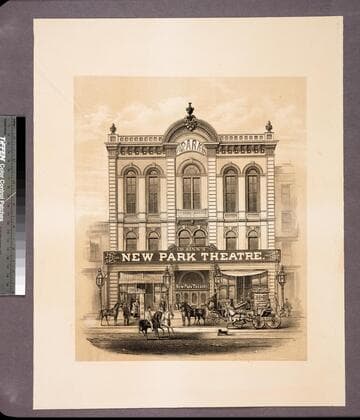
Visual Materials
Image of a view of the three-story facade of the New Park Theatre in Brooklyn, New York, managed by Colonel William E. Sinn, with carriages, a dog, and people on horseback on the street out front, two posters visible including one with the legible words "Happy Man," "Edward," and "Curry," and signs for the theatre including the date "1873."
priJLC_ENT_001015
Image not available
Visual Materials
This collection contains photographs, negatives, and some ephemera chiefly collected by California conservationist and editor William H. Thrall (1873-1963) for use in Trails magazine. Thrall served as managing editor of the publication from 1934 to 1939, which was produced to encourage the use of mountain trails and outdoor recreation in Los Angeles County. The collection includes approximately 1200 prints (Boxes 1-4); 68 glass negatives (Boxes 7-8); approximately 2300 film negatives; 150 slides; and miscellaneous documents and ephemera, and a folding pocket camera. The photographs primarily date from the 1930s, but also include copy prints (and some originals) of late 19th and early 20th photographs. The images depict mountain and forested landscapes and outdoor recreational activities including hiking, skiing, and camping, chiefly in the San Gabriel Mountains and surrounding mountains of Southern California. Many of the photographs include individuals involved in recreational activities as well images of historical mountain pioneers. The photographs chiefly consist of 4.5 x 2.75 inch snapshots and 8 x 10 and 6 x 10 inch prints, by photographers including Dan P. Alexander, Carl H. Bauer, Harlow Dormer, C. C. Vernon, and Thrall. There is also a group of glass plate negatives and film negatives, including a group of unprinted film negatives that appear to be personal photographs with views of nature, groups of people, family scenes, buildings, boating, and trips, in the 1930s-1950s (Box 15). The film negatives have handwritten numbers presumably assigned by Thrall. Many of the prints appear in Trails magazine, which was published quarterly by the Mountain League of Southern California from Winter 1934 to Spring 1939 (Volume 6, No. 1). In Autumn 1941, the Southern California Outdoor Federation began publishing a new edition of Trails Magazine (without Thrall as editor), but only two issues were published (Volume 2, Nos. 1-2).
photCL 481
Image not available
Rare Books
Here after too long an interval (six years since the appearance of 'M') is the new John Cage. And here too (three times six years, or near it, since 'Silence' came out) is the old John Cage as well. Which is to say: If you've read John Cage before, you're aware of some of his concerns: the nature and future of music; the ways of dancers (and their appetites); the concept of the world as Megalopolis set in global park; the ancient ides of Eastern civilizations (India, Japan) as they reverberate in seminal Western minds (Thoreau, Fuller, Brown); the several magics that reside in the art of the painter, in mushrooms and their habitats, in the clashes and harmonies of words whether arranged by change or by intent. All of these, in one fashion or another, are here in 'Empty Words'; none of them, however, quite as you have seen them before. Yes, of course, there are mesotics: some of them written by the author, more of them found by him (believe it or not) 'Finnegans Wake' by James Joyce. There are anecdotes, there are epigrams, there are even (something new for Mr. Cage) caustic analyses/criticisms of the world's political-economic situation and leadership. There are also drawings, borrowed from those made by Henry David Thoreau to illustrate his 'Journal' of 1837-1862. The section of this book in which they appear--derived at several removes from the same source--is called (like the whole volume) 'Empty Words.' Empty words? In this book, as in so much of everyday life, emptiness and beauty are in the mind/eye of you who experience them. These words lie open on the page for your consideration--each with its meaning(s) as defined by dictionaries; each also with overtones of sense and emotion derived in some measure from the given context, in some measure from its resonance when spoken aloud. Try reading, for example, the series re Morris Graves, first silently, then as a vocal exercise. You'll find it, like all of his books--like all of John Cage's writing--fresh, thought-provoking, fully of beauty and challenge"--From dust jacket.
657214