Rare Books
Daisies
Image not available
Daily: 10 A.M.–5 P.M.
Closed on Tuesdays
1151 Oxford Road
San Marino, CA 91108

Image not available
Visual Materials
A disbound album of primarily portrait photographs of Plains Indians, taken by photographer William E. Irwin from the 1890s to early 1900s, in Indian Territory. His images document the Chiricahua Apache, Comanche, and Kiowa Indians who lived near Anadarko and Fort Sill, Oklahoma; some photographs may have been taken at Irwin's studio at Chickasha, Indian Territory. Besides the studio and field portraits, there are also candid views illustrating late 19th-century Plains Indians in their daily lives; several views of cowboys and cow herding; Fort Sill; tepees; landscapes; and one view of a Wichita Indian grass house or wickiup. Notable portraits include those of Geronimo, seated, posing with headdress and revolver; Appeahtone (Kiowa Chief) and his wife; and Quanah Parker (Comanche Chief) with two of his wives. Many of the photographs focus on Comanche and Kiowa Indians posing for studio portraits. These portraits depict infants and children, young women, mothers, scouts, and warriors, many identified by name. Named individuals include Poor Buffalo, White Buffalo, Lone Wolf, and Little White Shield, among others. Field photographs show Apache, Kiowa, and Comanche encampments; a Wichita grass house; both cowboys and Indians caring for their herds; and views in and around Anadarko and Fort Sill, Oklahoma.
photCL 161
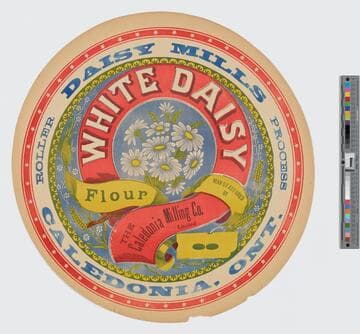
Visual Materials
Image of a White Daisy brand flour label from Caledonia Milling Company of Caledonia in Ontario, Canada; daisies at center surrounded by wheat stalks and stars in decorative borders.
priJLC_FOOD_003530
Image not available
Visual Materials
The Fanchon & Marco collection contains approximately 1400 photographs depicting hundreds of Fanchon and Marco Inc. sets and performers between approximately 1925 and 1938. The collection also includes three boxes of ephemera, dated from around 1912 to 1940, that consist of newspapers clippings, musical scores, miscellaneous photographs, and the supplemental press books that were included with Fanchon & Marco's promotional magazine, Now (later The Idea), dating from 1930 and 1931. The 16 volumes (now disbound) of photographs in this collection served as a visual inventory for hundreds of Fanchon & Marco sets and performers. The images document the actors, dancers, costumes, sets, and concepts and appear to have been primarily photographed during rehearsals before the shows premiered in Los Angeles theaters such as Loew's State Theater and the Paramount Theater. The first volume contains some photographs presumably taken in San Francisco and later volumes include a few photographs by New York-based photographers. Photographers represented in the collection are: Archer's Art Shop of Los Angeles; Hollywood photographers Irving Archer; Archer's Studios; Curt Fox; Paralta Studios; and Harry Wenger. A few photographs include the imprints of Peerless Photo of Los Angeles, John Sirgio, H.W. Steward of San Francisco, Talbot of New York, Weaver of Los Angeles, and White Studio of New York.
photCL 487
Image not available
Visual Materials
The Fanchon & Marco collection contains approximately 1400 photographs depicting hundreds of Fanchon and Marco Inc. sets and performers between approximately 1925 and 1938. The collection also includes three boxes of ephemera, dated from around 1912 to 1940, that consist of newspapers clippings, musical scores, miscellaneous photographs, and the supplemental press books that were included with Fanchon & Marco's promotional magazine, Now (later The Idea), dating from 1930 and 1931. The 16 volumes (now disbound) of photographs in this collection served as a visual inventory for hundreds of Fanchon & Marco sets and performers. The images document the actors, dancers, costumes, sets, and concepts and appear to have been primarily photographed during rehearsals before the shows premiered in Los Angeles theaters such as Loew's State Theater and the Paramount Theater. The first volume contains some photographs presumably taken in San Francisco and later volumes include a few photographs by New York-based photographers. Photographers represented in the collection are: Archer's Art Shop of Los Angeles; Hollywood photographers Irving Archer; Archer's Studios; Curt Fox; Paralta Studios; and Harry Wenger. A few photographs include the imprints of Peerless Photo of Los Angeles, John Sirgio, H.W. Steward of San Francisco, Talbot of New York, Weaver of Los Angeles, and White Studio of New York.
photCL 487