Rare Books
Works
Image not available
You might also be interested in
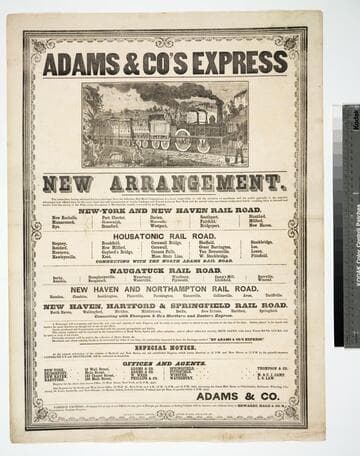
Adams & Co's Express : new arrangement. The subscribers have obtained Express privileges from the following Rail Road Corporations
Visual Materials
Image of a broadside announcing the railroad stops included in the Adams and Company's Express shipping services on various lines between New York and New England with a top center wood engraved image of a steam locomotive passenger train moving on tracks through the countryside with laborers in the foreground; the railroad companies listed are the New-York and New Haven Railroad, the Housatonic Railroad, the Naugatuck Railroad, the New Haven and Northampton Railroad, and the New Haven Hartford & Springfield Railroad.
priJLC_TRAN_001193
Image not available
New York, New Haven and Hartford Railroad Company
Rare Books
Includes (selected items): printed letter saying, "For the first time in the United States, a train will be operated today by remote control by the New Haven Railroad." Signed by Patrick B. McGinnis, Dec. 1, 1955. Also press releases on this topic.
646607
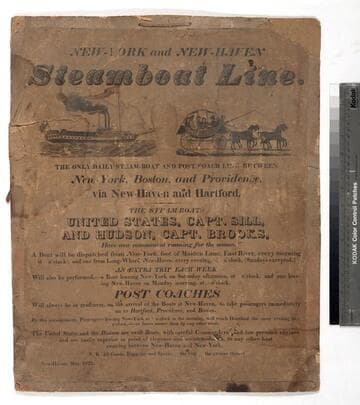
New-York and New-Haven steamboat line
Visual Materials
Image of an advertisement for the New York City to New Haven, Connecticut, steamboat line and coach line, with stops in Boston, Massachusetts, and Providence, Rhode Island; images of a steamboat and a horse-drawn stagecoach at center.
priJLC_MAR_001417
Image not available
1856 May-1857 December
Manuscripts
The collection contains letters, letterbooks, documents, records, and manuscripts that document Barlow's legal, business, and political career, and his cultural and social pursuits. Barlow's legal and business papers constitute the bulk of the collection and cover 1855 to 1889. This portion of the collection deals with financing, building and management of railroads -- both Eastern and Western divisions of the Ohio and Mississippi, the Atlantic & Great Western, the Atlantic, Mississippi & Ohio, the Little Miami, the Columbus and Xenia, the Erie, and the New York, Erie & Western; Barlow's lobbying on behalf of Texas and Pacific Railroad Company and the Pacific Mail Steamship Company; his involvement in the affairs of the Tehuantepec railroad route in Mexico, mining promotions and operations, including the notorious Arizona diamond hoax; land speculation (farm lands in Illinois, Iowa, and Ohio and urban properties in St. Louis, Mo.); his patronage of the New York subway and telephone enterprises, and his part ownership of the New York World. Political and military correspondence and manuscripts cover Barlow's involvement in Democratic politics at both national and state levels, that started in 1856 and continued until his death. The papers deal with Barlow's role in the nomination of James Buchanan for President, 1856, and his administration; Democratic National Convention at Charleston, 1860; George McClellan's presidential bid, the National Union Club, congressional elections, Tilden, Hancock, and Cleveland campaigns, 1876 to 1886. This portion of the collection also contains reports from the Eastern theater of the Civil War that Barlow received from his agents in the field. Among the correspondents are William T. Sherman, and T.J. Barnett, a minor official at the Department of the Interior and the Washington correspondent of the New York Journal of Commerce, who provided an insight into Lincoln's White House. Also included are items reflecting Barlow's role in social and cultural life of New York -- his friendship with William Cullen Bryant and Bret Harte, patronage of the Metropolitan Museum of Art, the New York Academy of Music, and the New York Historical Society, his collections of colonial Americana and rare books, etc. Correspondents include William Henry Aspinwall, Henry Douglas Bacon, T.J. Barnett, James Asheton Bayard, Jr., August Belmont, Judah Philip Benjamin, Montgomery Blair, William Montague Browne, Benjamin Franklin Butler, Roscoe Conkling, George Ticknor Curtis, John Henry Dillon, William Maxwell Evarts, Henry Harrisse, Ben Holladay, Hugh Judge Jewett, Clarence King, George Brinton McClellan, James McHenry, Manton Malon Marble, Thomas Alexander Scott, Horatio Seymour, William Davis. Materials created by US presidents in this collection include James Buchanan autograph letters signed to Samuel L.M. Barlow, 1867 May 2 and May 22; Grover Cleveland autograph letter signed to Samuel L.M. Barlow, 1884 October 12; Millard Fillmore autograph letter signed to Charles Day, 1870 October 12; Andrew Jackson autograph letter to Mahlon Dickerson, 1835 June 9; also present is a contemporary copy of Ulysses S. Grant and Robert E. Lee special order to Thomas Mann Randolph Talcott regarding Confederate soldiers paroled at Appomattox, 1865 April 10.
mssBW
Image not available
1868
Manuscripts
The collection contains letters, letterbooks, documents, records, and manuscripts that document Barlow's legal, business, and political career, and his cultural and social pursuits. Barlow's legal and business papers constitute the bulk of the collection and cover 1855 to 1889. This portion of the collection deals with financing, building and management of railroads -- both Eastern and Western divisions of the Ohio and Mississippi, the Atlantic & Great Western, the Atlantic, Mississippi & Ohio, the Little Miami, the Columbus and Xenia, the Erie, and the New York, Erie & Western; Barlow's lobbying on behalf of Texas and Pacific Railroad Company and the Pacific Mail Steamship Company; his involvement in the affairs of the Tehuantepec railroad route in Mexico, mining promotions and operations, including the notorious Arizona diamond hoax; land speculation (farm lands in Illinois, Iowa, and Ohio and urban properties in St. Louis, Mo.); his patronage of the New York subway and telephone enterprises, and his part ownership of the New York World. Political and military correspondence and manuscripts cover Barlow's involvement in Democratic politics at both national and state levels, that started in 1856 and continued until his death. The papers deal with Barlow's role in the nomination of James Buchanan for President, 1856, and his administration; Democratic National Convention at Charleston, 1860; George McClellan's presidential bid, the National Union Club, congressional elections, Tilden, Hancock, and Cleveland campaigns, 1876 to 1886. This portion of the collection also contains reports from the Eastern theater of the Civil War that Barlow received from his agents in the field. Among the correspondents are William T. Sherman, and T.J. Barnett, a minor official at the Department of the Interior and the Washington correspondent of the New York Journal of Commerce, who provided an insight into Lincoln's White House. Also included are items reflecting Barlow's role in social and cultural life of New York -- his friendship with William Cullen Bryant and Bret Harte, patronage of the Metropolitan Museum of Art, the New York Academy of Music, and the New York Historical Society, his collections of colonial Americana and rare books, etc. Correspondents include William Henry Aspinwall, Henry Douglas Bacon, T.J. Barnett, James Asheton Bayard, Jr., August Belmont, Judah Philip Benjamin, Montgomery Blair, William Montague Browne, Benjamin Franklin Butler, Roscoe Conkling, George Ticknor Curtis, John Henry Dillon, William Maxwell Evarts, Henry Harrisse, Ben Holladay, Hugh Judge Jewett, Clarence King, George Brinton McClellan, James McHenry, Manton Malon Marble, Thomas Alexander Scott, Horatio Seymour, William Davis. Materials created by US presidents in this collection include James Buchanan autograph letters signed to Samuel L.M. Barlow, 1867 May 2 and May 22; Grover Cleveland autograph letter signed to Samuel L.M. Barlow, 1884 October 12; Millard Fillmore autograph letter signed to Charles Day, 1870 October 12; Andrew Jackson autograph letter to Mahlon Dickerson, 1835 June 9; also present is a contemporary copy of Ulysses S. Grant and Robert E. Lee special order to Thomas Mann Randolph Talcott regarding Confederate soldiers paroled at Appomattox, 1865 April 10.
mssBW
Image not available
1866
Manuscripts
The collection contains letters, letterbooks, documents, records, and manuscripts that document Barlow's legal, business, and political career, and his cultural and social pursuits. Barlow's legal and business papers constitute the bulk of the collection and cover 1855 to 1889. This portion of the collection deals with financing, building and management of railroads -- both Eastern and Western divisions of the Ohio and Mississippi, the Atlantic & Great Western, the Atlantic, Mississippi & Ohio, the Little Miami, the Columbus and Xenia, the Erie, and the New York, Erie & Western; Barlow's lobbying on behalf of Texas and Pacific Railroad Company and the Pacific Mail Steamship Company; his involvement in the affairs of the Tehuantepec railroad route in Mexico, mining promotions and operations, including the notorious Arizona diamond hoax; land speculation (farm lands in Illinois, Iowa, and Ohio and urban properties in St. Louis, Mo.); his patronage of the New York subway and telephone enterprises, and his part ownership of the New York World. Political and military correspondence and manuscripts cover Barlow's involvement in Democratic politics at both national and state levels, that started in 1856 and continued until his death. The papers deal with Barlow's role in the nomination of James Buchanan for President, 1856, and his administration; Democratic National Convention at Charleston, 1860; George McClellan's presidential bid, the National Union Club, congressional elections, Tilden, Hancock, and Cleveland campaigns, 1876 to 1886. This portion of the collection also contains reports from the Eastern theater of the Civil War that Barlow received from his agents in the field. Among the correspondents are William T. Sherman, and T.J. Barnett, a minor official at the Department of the Interior and the Washington correspondent of the New York Journal of Commerce, who provided an insight into Lincoln's White House. Also included are items reflecting Barlow's role in social and cultural life of New York -- his friendship with William Cullen Bryant and Bret Harte, patronage of the Metropolitan Museum of Art, the New York Academy of Music, and the New York Historical Society, his collections of colonial Americana and rare books, etc. Correspondents include William Henry Aspinwall, Henry Douglas Bacon, T.J. Barnett, James Asheton Bayard, Jr., August Belmont, Judah Philip Benjamin, Montgomery Blair, William Montague Browne, Benjamin Franklin Butler, Roscoe Conkling, George Ticknor Curtis, John Henry Dillon, William Maxwell Evarts, Henry Harrisse, Ben Holladay, Hugh Judge Jewett, Clarence King, George Brinton McClellan, James McHenry, Manton Malon Marble, Thomas Alexander Scott, Horatio Seymour, William Davis. Materials created by US presidents in this collection include James Buchanan autograph letters signed to Samuel L.M. Barlow, 1867 May 2 and May 22; Grover Cleveland autograph letter signed to Samuel L.M. Barlow, 1884 October 12; Millard Fillmore autograph letter signed to Charles Day, 1870 October 12; Andrew Jackson autograph letter to Mahlon Dickerson, 1835 June 9; also present is a contemporary copy of Ulysses S. Grant and Robert E. Lee special order to Thomas Mann Randolph Talcott regarding Confederate soldiers paroled at Appomattox, 1865 April 10.
mssBW