Rare Books
On the Makaloa mat
Image not available
Daily: 10 A.M.–5 P.M.
Closed on Tuesdays
1151 Oxford Road
San Marino, CA 91108

Image not available
Manuscripts
A.Ms. 1 p. 4to. Also: newspaper clipping.
JL 211
Image not available
Visual Materials
The Greene and Greene Collection contains a wide variety of materials, from Greene and Greene ancestor, architect/engineer James Sumner's "Memo of the Timber wanted for the Steeple in Providence," dated 1775, and a diary of a European grand tour from 1829 to 1931 by an English ancestor of Charles Greene's wife, Alice, to drawings and photographs of Greene and Greene works from the time of construction through the close of the 20th century. The bulk of the collection dates from 1889 to 1975. Photographs comprise most of the records documenting their architecture. There is a small number of architectural drawings; most of the firm's drawings are housed at the Avery Architectural and Fine Arts Library at Columbia University, New York City, with a smaller collection of drawings from the estate of Charles Greene at the Environmental Design Archives, University of California, Berkeley. The collection is organized into four series: I. Personal papers, II. Office records, III. Job (project) records (including furniture), and IV. Related research materials. In general, the papers and records of both brothers have been kept together for the periods in which they were living together as students and young men, and for the period when they were partners in the firm of Greene and Greene. Within each series, the organization follows the separate lives and works of each brother from the dates at which they diverge. Although the collection has been assembled from many different sources, most items have a unique accession number identifying the donor, so that the researcher can easily identify the source of most documents.
archGreene
Image not available
Manuscripts
A collection of approximately 30,000 items which consists of letters, manuscripts, documents, diaries, sketches, photographs, printed material, and scrapbooks related to the lives and work of Charles Erskine Scott Wood and Sara Bard Field Wood. The collection includes material about William Maxwell Wood (1809-1880), C.E.S. Wood's father; papers from C. E. S. Wood's army career, including materials from West Point, Alaska, and the Indian campaigns in the Pacific Northwest; C. E. S. Wood's activities in the development of eastern Oregon (note: there are no papers belonging to Wood's law office); Sara Bard Field's reports on the McNamara case, her life in San Francisco and her associations with journalists, labor leaders, Soviet sympathizers, pacifists, and artists; materials related to Sara Bard Field's work for woman suffrage and women's rights; and C.E.S. Wood and Sara Bard Field Wood's cultural circle, including letters from other writers, critics, publishers, social reformers, artists, sculptors, theatrical figures and musicians. Persons represented in the collection include politicians, journalists, cultural leaders, artists, suffragists, authors, and musicians: Charles Altschul, Roger Nash Baldwin, Alva Belmont, Albert M. Bender, William Rose Beňt, Henriette de S. Blanding, Alfred Brennan, Maurice Browne, George De Forest Brush, Beniamino Bufano, Witter Bynner, Bennett Cerf, Samuel Langhorne Clemens, Clarence Darrow, Kenneth Durant, Max Eastman, Gilson Gardner, Inez Haynes Gillmore, William Hanley, Walter Morris Hart, Childe Hassam, Nan Wood Honeyman, O.O. Howard, Robinson Jeffers, Willard Maas, Alexander Meiklejohn, Eugene Meyer, Josephine Miles, Harriet Monroe, Richard L. Neuberger, Frederick O'Brien, Mrs. Fremont Older, Fremont Older, Lemuel Parton, Alice Paul, Lute Pease, Louis Freeland Post, John Cowper Powys, Llewelyn Powys, Alexander Phimister Proctor, John W. Redington, Corinne Roosevelt Robinson, Muriel Rukeyser, Albert Pinkham Ryder, Theodore Spiering, Lincoln Steffens, Walter Steilberg, Doris Stevens, Genevieve Taggard, Mark Van Doren, Mabel Vernon, Langdon Warner, Olin Levi Warner, Julian Alden Weir, Marie de L. Welch, George P. West, Frances G. Wickes, Ella Winter, Emma Wold, Erskine Wood, Art Young, and Ella Young.
mssWD
Image not available
Visual Materials
The Singleton Collection is organized into four discrete yet interrelated units. The first consists of 79 photographs by Mathew Brady (1823-1896) and Alexander Gardner (1821-1882) of scenes of the Civil War taken between 1861 and 1865. Included are group portraits of generals with their staffs, important wartime sites and activities, and photographs of paintings depicting various skirmishes. While the photographs were taken by Brady and Gardner during the war, the images were printed around 1885 by John Taylor and marketed by the firm of Taylor & Huntington. These photographer-entrepreneurs hoped to capitalize on twenty-fifth anniversary war reunions and commemorations by reissuing the once-familiar views. On the verso of each image is a partial list of the photographs sold by Taylor & Huntington for 75 cents a piece. The second grouping of photographs depicts two views of Abraham Lincoln and portraits of the Lincoln conspirators and their execution. These were also taken by Brady and Gardner during the war and, as with the first group, printed and issued around 1885 by Taylor & Huntington. Of particular rarity are the fourteen photographs of the Lincoln assassination conspirators including portraits of David Herold, George Atzerodt, Edward Spangler, two views of Lewis Payne, two views of Michael O'Laughlin, and an unidentified conspirator. Additionally, there is a complete set of three images depicting the execution of Mrs. Surratt and the conspirators taken by Alexander Gardner on July 7, 1865, as well as three of the five known images documenting the execution of Captain Wirz, the notorious Keeper of Andersonville Prison. Eighty-three cabinet portraits of Confederate Generals and other Southern leaders by George S. Cook (1819-1902) comprise the third section of the collection. Cook was a friend and former employee of Matthew Brady, and he provided E.& H.T. Anthony Co. with portraits from the South, including the first portrait of Colonel Robert Anderson. These portraits may come from sources other than Cook as he purchased competing photographers negatives, issuing them on his mounts. These portraits were taken in the 1860s but printed between 1880 and 1890 when Cook operated his Richmond, Virginia studio at 913 East Main Street. The last grouping of photographs contains 210 images by William H. Tipton (1850-1929), the self-described "Battlefield Photographer." The imperial-sized photographs depict the numerous monuments erected on the Gettysburg battlefield to honor the soldiers who fought and died in this decisive battle. The photographs date from the 1880s. The Singleton Collection constitutes of one of the most complete historic archives of the Gettysburg monuments.
Visual Materials
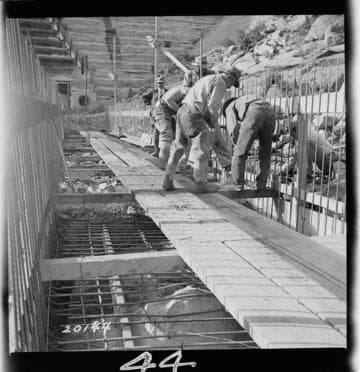
Showing foundation mat steel in foreground and portion of mat concrete in background.
photCL SCE 02 - 20144
photCL 445