Rare Books
Hunt clubs and country clubs in America
Image not available
You might also be interested in
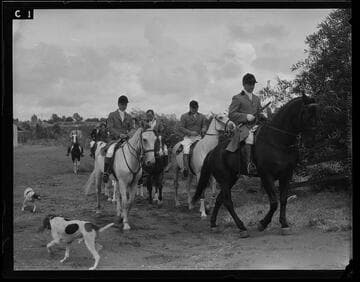
Fox hunt at the Riviera Country Club, Santa Monica Canyon
Visual Materials
Image of men and women in hunting attire with horses and dogs for a fox hunt at the Riviera Country Club in Santa Monica Canyon in Pacific Palisades, California.
photCL_555_06_742
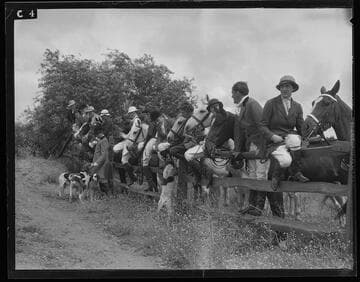
Fox hunt at the Riviera Country Club, Santa Monica Canyon
Visual Materials
Image of men and women in hunting attire resting at a wooden fence with their horses and dogs while fox hunting at Riviera Country Club in Santa Monica Canyon in Pacific Palisades, California.
photCL_555_06_743
Image not available
Carrizo Hunting Club
Manuscripts
The collection consists of the personal and business papers of Los Angeles businessman Henry Workman Keller (1869-1958) and is comprised of approximately 7985 pieces. Many of the papers are bound together in files so that one item may contain up to 500 or more letters.It includes papers related to land in California and Mexico, agriculture (including materials on the prune and rice industries, irrigation and flood control) in Colusa County, California, and mining (including copper, lead and zinc mines) in Mexico. There are also materials related to the citrus fruit industry, the Automobile Club of Southern California, and the Mexican Revolution (1910-1920). Correspondents represented in the collection include: Harry Chandler, John Page Crutcher, Edward Fletcher, Llewellyn A. Luce, John G. Mott, Epes Randolph, Ygnacio Sepúlveda, Henry H. Timken, and William L. Valentine. Businesses with which Henry Workman Keller (1869-1958) was association which are represented in the collection include: the San Isidro Ranch Company, the Thousand Acre Ranch Company, and the San Manuel Mines Company and its subsidiaries.
mssKellerh
Image not available
Hunt Club and cabin
Visual Materials
This collection contains photographs, negatives, and some ephemera chiefly collected by California conservationist and editor William H. Thrall (1873-1963) for use in Trails magazine. Thrall served as managing editor of the publication from 1934 to 1939, which was produced to encourage the use of mountain trails and outdoor recreation in Los Angeles County. The collection includes approximately 1200 prints (Boxes 1-4); 68 glass negatives (Boxes 7-8); approximately 2300 film negatives; 150 slides; and miscellaneous documents and ephemera, and a folding pocket camera. The photographs primarily date from the 1930s, but also include copy prints (and some originals) of late 19th and early 20th photographs. The images depict mountain and forested landscapes and outdoor recreational activities including hiking, skiing, and camping, chiefly in the San Gabriel Mountains and surrounding mountains of Southern California. Many of the photographs include individuals involved in recreational activities as well images of historical mountain pioneers. The photographs chiefly consist of 4.5 x 2.75 inch snapshots and 8 x 10 and 6 x 10 inch prints, by photographers including Dan P. Alexander, Carl H. Bauer, Harlow Dormer, C. C. Vernon, and Thrall. There is also a group of glass plate negatives and film negatives, including a group of unprinted film negatives that appear to be personal photographs with views of nature, groups of people, family scenes, buildings, boating, and trips, in the 1930s-1950s (Box 15). The film negatives have handwritten numbers presumably assigned by Thrall. Many of the prints appear in Trails magazine, which was published quarterly by the Mountain League of Southern California from Winter 1934 to Spring 1939 (Volume 6, No. 1). In Autumn 1941, the Southern California Outdoor Federation began publishing a new edition of Trails Magazine (without Thrall as editor), but only two issues were published (Volume 2, Nos. 1-2).
photCL 481
Image not available
Country clubs. Morro Country Club; Unidentified
Visual Materials
The Eugene Swarzwald Pictorial California and the Pacific Collection consists of 9,674 black and white photographs, negatives, a photograph album, magazine mock-ups, letters, and ephemera, dated 1909-ca. 1968. Eugene Swarzwald and the Swarzwald family collected the material for use in the magazine "Pictorial California and the Pacific." Images depict California and the West with some coverage of the rest of the United States and international destinations. The collection contains photographs depicting general city views of communities in California, scenic views of wilderness areas, images of parks, schools and universities, museums, and points of historic interest (including California mining towns and missions). The collection is strong in subjects related to leisure and social and recreational activities. Many of the photographs are by the Keystone Photo Service. Other photographers include Chuck Abbott, Adelbert Bartlett, Lionel T. Berryhill, Lil and Al Bloom, Hal Boucher, Campbell-Ricco-Mazzuchi Photography, Caroll Photo Service, Garth Chandler, Walter J. Collinge, Fairchild Aerial Surveys, George O. Fales, Frasher's, J. P. Graham, Dean Hesketh Company, Charles M. Hiller, Pat and G. E. Kirkpatrick, Don Knight, Albert J. Kopec, Ward Linton, Lothers and Young, Hubert A. Lowman, David M. Mills, Don Milton, Gabriel Moulin Studios, Karl Obert, Earle O'Day, Pacific Air Industries Aerial Photography, Dave Packwood, Padilla Studios, Maynard L. Parker, Jack W. Patterson, Julius Shulman, Spence Air Photos, H. W. Steward, Thiem, Harry Vroman, Whithurse Aerial Photos, and Steven H. Willard.
photCL 310
Image not available
CAPITOL HUNTING & FISHING CLUB
Manuscripts
Collection consists mainly of correspondence from the period 1910-14, beginning when Oddie initiated his campaign for governor and ending when he was about to terminate his administration. The correspondence is arranged in 19 boxes in alphabetical order by author. There are also 6 boxes and 4 rolls of Nevada State papers, almost entirely copies of legislative bills for the year 1873, and a small number of documents from other years. Subjects include: mining, politics, and government in Nevada (including divorce laws), women's rights, the financial panic of 1907, the Progressive party, and the Panama-Pacific International Exposition of 1915.
mssOddie