Rare Books
Memoir of the Northern Kingdom
Image not available
You might also be interested in
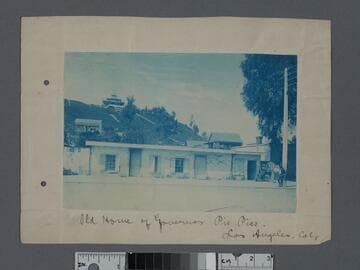
Old home of Governor Pio Pico Los Angeles, Cal
Visual Materials
View of an adobe building on New High Street at the intersection with Republic at the base of Fort Moore Hill (also known as Fort Hill) in the Plaza neighborhood (also called Sonora Town) of downtown Los Angeles, California, on New High Street. The Banning mansion visible at the top and a sign reading "Herald" can be seen at lower right.
photCL_555_01_253
Image not available
Certificate of land warrant
Manuscripts
This item is a numbered certificate indicating that an individual has paid $500 to the Independence Loan Fund of the Republic of Sonora, for which he will receive one league of land in the public domain. Printed form, numbered 68, and signed by William Walker, but no name of the payer is entered. It was Walker's intent to create a Republic of Sonora, but his plans were not sanctioned by either Mexico or the United States.
mssHM 4105
Image not available
Reed Peck memoir
Manuscripts
The original of the Reed Peck Manuscript, an 1839 memoir criticizing Mormon actions in Missouri during the conflicts of 1838. Peck opens with a prophecy about "redeeming" Zion (Missouri) through armed force, the "interpretation" of which led Joseph Smith to call for volunteers to march to Clay County "under arms" (they were waylaid by a cholera outbreak). Peck goes on to relate alleged financial and power conflicts in Kirtland, Ohio, between, among others, Joseph and Hyrum Smith, Sidney Rigdon, and Oliver Cowdery, as well as disagreements over where in Missouri to establish a Mormon settlement. He writes that once the Mormons had settled in Caldwell County, the Mormon presidency became a "despotic government" and that it proposed a policy, encouraged by Rigdon, that dissenters from the Church be killed so that "they would not be capable of injuring the church." He goes on to say that the Mormon leadership demanded that all followers consecrate their property to the Church or be turned over to the "terrible brother of Gideon" (Jared Carter) for punishment. Peck continues that he and some others were "ever after ... opposed to the rule of the presidency" because "their word was law in religious, civil and military matters." He writes of the formation of a "secret military organization" (the Danites) by Carter, George W. Robinson, and Sampson Avard "under the instruction of the presidency," and of pretending to join the group, although he avoided taking the official oath and "declared to my trusty friends that I would never act in the office." He also remembers that Carter was later found guilty of criticizing the presidency, and alleges that he heard Joseph Smith say he would have "cut his throat on the spot" if he had been alone. The remainder of the memoir recounts the events of the Mormon War, in which Peck claims that hostilities between Mormons and Gentiles were inflamed by Joseph Smith. He begins with disputes over an election in Daviess County, leading to a "skirmish" which he says was exaggerated into accounts of a "bloody massacre of ... Mormons," leading non-Mormon citizens to fear retaliation and call for the expulsion of the Mormons from Daviess County. He criticizes the Mormons for initiating confrontations, plundering goods, and for attacking the militia under Capt. Bogart at the Battle of Crooked River, but he condemns the attack on Mormons in the Haun's Hill Massacre. He concludes his narrative of events with the arrest and subsequent escape of the Smiths, Rigdon, Wight, Parley Pratt, and others. He closes the manuscript by condemning Smith and the Church ("how can he [Smith] expect to support his character as a man of God when facts are exhibited to the world in their true light," he wrote) and by listing the sources for his narrative, much of which was allegedly based on his own eyewitness accounts. Other individuals mentioned in the memoir include W.W. Phelps, Edward Partridge, John Corrill, and Dimmock Baker Huntington. There appear to be pages missing after page 152.
mssHM 54458
Image not available
Reminiscences -- Work & Home A Sort of Memoir of My Early Years, (1999, Oct.)
Manuscripts
The core of the Manuel H. Rodriguez papers are his thoughtful and informative reminiscences. There are over 20 narrations of his past experiences. They cover his service in the United States Army to his years as a student at the University of California, Los Angeles. He wrote about the economic effects of the Great Depression in Los Angeles, where an overwhelming amount of men worked as an itinerant salesman to ordinary activities such as playing marbles. Rodriguez wrote, "I have enjoyed reminiscing about those years and the exercise of my memory has had therapeutic effects," Box 9 (16). Many of Rodriguez's reminiscences could be accessed on his son's website: Zòcalo.
mssRodriguez
Image not available
Sampson & Tappan letter to Captain George Sweetlin
Manuscripts
Interesting letter showing trade and commerce of the Gold Rush era. Sampson & Tappan write to the captain of their ship "Fanny Forester" (no doubt a nod to the nom de plume of the then popular author Emily C. Judson), stating that they had received the news of his charter party who had promised to send a fee of $1500. The charter party was Alfred Robinson (1806-1895), a businessman from Boston, who sailed to California in 1829 in the employ of Bryant, Sturgis and Company, a firm in the hide and tallow trade. Robinson was the author of Life in California (1846), an influential early description of the politics of the region under the Mexican Republic. Sampson & Tappan also write: "We are much pleased to hear that the ship is in such good order & That the leak is not so troublesome. We notice what you propose doing with the provisions & doubt not that you will manage them to best advantage." They note that they will soon be boarding the Carthage for San Francisco and "she will get away about 15 to 20 September."
mssHM 82559
Image not available
Sixty years in California : a history of events and life in California; personal, political and military, under the Mexican regime; during the quasi-military government of the territory by the United States, and after the admission of the state into the union, being a compilation by a witness of the events described
Rare Books
William Heath Davis (1822-1909) was the son of a Boston ship captain engaged in the Hawaiian trade and a Polynesian mother. After visiting California twice on trading voyages that took him all around South and North America, he settled in Monterey to work with his merchant uncle in 1838. In 1845 he settled permanently in San Francisco, becoming one of the city's leading merchants. His marriage to María de Jesus Estudillo tied him to the Hispanic community in his adopted region. Davis loved the easy life of the Californios, the descendants of the Mexicans who had arrived in Alta California in the late 1770s. He found them the happiest and most contented people he had ever known. Davis managed to meet almost every prominent man and woman who lived in or passed through California. He was one of the founders of New Town (now downtown San Diego). He served on San Francisco's first city council; he built San Francisco's first brick building and cofounded San Leandro.
2308