Opening Hours
Daily: 10 A.M.–5 P.M.
Closed on Tuesdays
1151 Oxford Road
San Marino, CA 91108
Rare Books
Image not available
Daily: 10 A.M.–5 P.M.
Closed on Tuesdays
1151 Oxford Road
San Marino, CA 91108

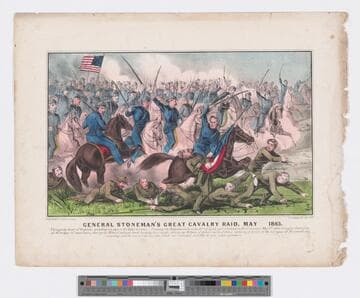
Visual Materials
Image of Union cavalry under the leadership of General George Stoneman charging on horseback past fallen and wounded Confederate soldiers during the American Civil War.
priJLC_MIL_000932
Image not available
Manuscripts
The collection consists primarily of military records accumulated by the headquarters of Union Army General Joseph Hooker from October 1861 through September 1864, along with two documents from the 1870s. The papers relate to the battles of Antietam, Brandy Station, Second Bull Run, Fair Oaks, Chancellorsville, Fort Donelson, Fort Henry, the Seven Days Battles, Malvern Hill, South Mountain, and Williamsburg, as well as the Siege of Yorktown. They focus on the Union Army’s Peninsula Campaign of 1862 and Gettysburg Campaign of 1863, with most events taking place in Virginia, Maryland, and Pennsylvania. The records document the movements of the XX Corps of the Army of the Cumberland, the Army of the Potomac, and the III Corps of the Army of Virginia. Materials include correspondence, general orders, dispatches, telegrams, reports, reconnaissance reports, and lists of battle casualties and prisoners taken. The collection contains records involving senior military leaders, including William Averell, Daniel Butterfield, George H. Chapman, Joseph Dickinson, Abner Doubleday, Thomas Eckert, George W. Getty, Ulysses S. Grant, Henry W. Halleck, Samuel Heintzelman, R. B. Marcy, George McClellan, George Meade, Henry Naglee, Alfred Pleasonton, John Sedgwick, Daniel Sickles, Edwin Stanton, George Stoneman, John D. Tidball, William Whipple, and Seth Williams. Other military figures mentioned include George Custer, Jeb Stuart, and James Longstreet. Several items are copies of dispatches and telegrams to and from President Abraham Lincoln, who is also mentioned elsewhere in the papers. The collection documents escaped enslaved people in military camps, including some who worked for the Union Army, as well as enslavers seeking them. Free African Americans and African American troops are also mentioned. Additional subjects include Port Tobacco, Maryland; the Rappahannock River region, Virginia; cavalry operations; Sickles' Excelsior Brigade; the military use of balloons; courts-martials; and disciplinary incidents involving drunkenness, desertion, and other infractions. The collection also contains hand-drawn and printed maps of military movements and battles, several Civil War–related books owned by Joseph Hooker, and a printed series of General Orders.
mssHooker
Image not available
Rare Books
100130
Image not available
Manuscripts
This collection contains the papers of English art historian Katharine Ada Esdaile (1881-1950), with the bulk of the materials relating to her research and writings on British monumental sculpture, sculptors, and church monuments from the medieval period to 19th century. Material types include personal writings, diaries, correspondence, business papers, family papers and photographs, research files and research notebooks, and miscellaneous published and unpublished materials. Notably the collection includes more than 600 chiefly pre-World War II visitor booklets and pamphlets produced locally by British churches and approximately 3500 photographs taken or collected by Esdaile of sculpture, often funerary monuments in English churches, ranging from large churches like Westminster Abbey to small rural parishes. This collection provides a resource for viewpoints on monumental sculpture in the early 20th century (for instance as represented in book reviews by Esdaile) and for information about Esdaile's experience as a woman art historian in the early 20th century. Given the broadness of Esdaile's scope, from medieval to 19th century British monumental sculpture, the collection is less useful for specific information about monuments or sculptors. In addition, many of Esdaile's attributions in her notes appear to have been based primarily on her own instincts and do not have citations. Many of Esdaile's notes are handwritten on small scraps of paper or are fragments, sometimes making the information difficult to parse. The collection is chiefly Esdaile's files, but the dates on some items (such as post-1950 booklets) indicate the collection was added to and used after her death, presumably by her son Edmund Esdaile, who also made notes on items in the collection and appears to have done the preliminary organization of the papers after Esdaile's death.
mssEsdaile